

euglenophyte
- noun
- /juːˈɡlɛnəˌfaɪt/
- Specialized
- Scientists observed the behavior of euglenophyte cells under a microscope.
Examples
-
A euglenophyte can photosynthesize when light is available, but may also absorb nutrients directly.
-
Many euglenophytes thrive in freshwater environments.
-
Some species of euglenophyte are found in both freshwater and marine environments.
-
The euglenophyte is known for its unique flagellum.
-
A euglenophyte is a type of single-celled organism that can be found in various aquatic habitats.
-
In aquatic ecosystems, the presence of euglenophyte species can indicate good water quality.
-
Researchers study euglenophyte cells to understand their unique adaptations to different environmental conditions.
Synonyms

 4
3.6
4
3.6

A simple green plant that grows in water and has no roots, stems, or leaves
 1
9.9
1
9.9
A tiny living thing made of one cell that moves with whip-like tails
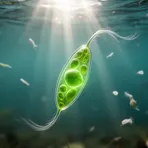
A single-celled water organism with a whip-like tail that often makes food from light
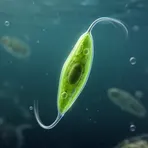
A one-celled living thing in fresh and salt water that moves with a whip-like tail

A one-celled water living thing that makes food from light and moves with a tail

A living thing whose cells have a nucleus inside a membrane like plants and animals
Surface Forms
Morphology
euglenophyte = Euglena (opaque) = eugleno + phyte
This is a specialist scientific coinage: the combining form 'eugleno-' refers to the genus Euglena and '-phyte' means plant-like, but the term is technical and not derivable by an average B1 learner.
Etymology
Euglenophyte comes from Euglena (a Greek name meaning 'good eye') and -phyte (meaning 'plant'). That fits because these tiny, single-celled water organisms often have an 'eyespot' and can behave like plants by making food from light.