
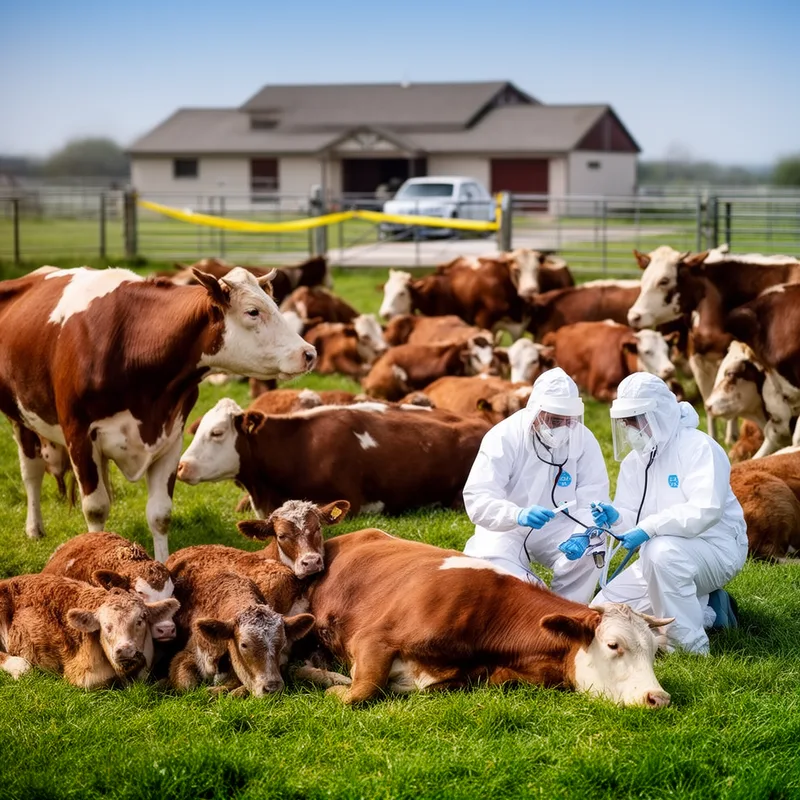
epizootic
- adjective
- /ˌɛpɪzuˈɑtɪk/
- Specialized
- Farmers were alerted to the risk of an epizootic disease that could decimate livestock populations.
- epizootic disease
- epizootic outbreak
Examples
-
An epizootic catarrhal enteritis (ECE) was first recognized in domestic ferrets (Mustela putorius furo) in the United States in 2000.
Academic text (2014) -
Their research has led to improved diagnostic procedures for bluetongue viruses and related viruses that cause epizootic hemorrhagic disease, or EHD.
Academic text (1999) -
Sea lice are endemic to the region but have low natural abundance and minimal host damage in the wild; in fact, there is only one pre-aquaculture report of an epizootic spread of sea.
Academic text (2003) -
These include isolates from disease outbreaks in Africa, Europe, the Caribbean, and, more recently, from the Russian/Trans-Caucasian epizootic and attenuated variants.
Academic text (2015) -
Since Cx. pipiens had been shown to be a potential bridge vector (Turetl et al., 2005), this shift might increase the risk of epizootic transmission in future seasons.
Academic text (2006) -
The black-footed ferret is not unique; most of Earth's biodiversity exists in habitats that are sensitive to epizootic disease outbreaks and drastic shifts in human social and political structure.
Academic text (1997) -
As that epizootic waned in the mid-1970s, Bonamia ostreae, another protistan parasite, increased to epizootic proportions and further reduced populations of O. edulis.
Academic text (1992) -
Our results show that two ferret coronaviruses that cause feline infectious peritonitis-like disease and epizootic catarrhal enteritis are enzootic among ferrets in Japan.
Academic text (2014) -
During the same period, populations of the European fiat oyster, Ostrea edulis, were also affected severely by epizootic disease (Comps, 1970; Comps et al., 1980).
Academic text (1992) -
The rapid spread of the virus resulted in an epizootic outbreak affecting thousands of deer in the region.
Compounds

- Specialized
A disease that affects many animals in one group, like an epidemic in people
How Widespread


Surface Forms
Morphology
epizootic = zootic (semi-transparent) = epi + zoo + tic
Formed by prefixing 'epi-' to the technical adjective 'zootic'; the elements are regular but both parts are specialized, so many learners may not immediately infer the meaning.
Etymology
The word epizootic comes from the parts epi- meaning 'on' or 'over' and zoo meaning 'animal', like the familiar word zoo. So it describes an outbreak that happens 'on' animals, an epidemic affecting many animals in one area.