

entrenchment
 1
8.6
1
8.6

- noun
- /ɪnˈtrɛnʧmənt/
- Specialized
- The troops fortified their position by digging deep entrenchments to defend against enemy fire.
Examples
-
During the siege, the soldiers retreated to their entrenchments, where they built barricades for protection.
-
Although "sensible" of the need for the British to request terms, d'Estaing complained that the British continued to build entrenchments.
Academic text (2014) -
The French were successful with the first charge and then took the strong German entrenchments on the Morepaw Comblay Rd.
-
One platoon of T-34s launched an assault against the German lines, but was unable to dislodge the White Pioneers from their entrenchments.
Blog text (1) -
Ultimately, though, d'Estaing assured Prvost: "The construction of entrenchments is a matter of very little importance; however, for form's sake, I must desire that you desist during our conferences."
Academic text (2014) -
In a 1776 letter to his wife, General Israel Putnam praised Strickland's "bravery and fearlessness" in defending the Brooklyn Heights entrenchments.
Fiction book (1993) -
Thomas examined the abandoned entrenchments around the town and notified Sherman, who remained in Kingston, that "the enemy had a very strong position there, and had commenced a series of very formidable breastworks and batteries."
Academic text (2007) -
The general ordered the construction of entrenchments to secure the army's defensive line against an impending attack.
Synonyms
 725
8.1
725
8.1
A defended position where soldiers stand during fighting
 9
6.6
9
6.6
A wall or earth mound built to protect a place from attack
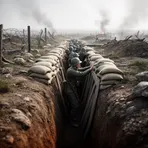
A defensive position where soldiers stand behind trenches during war
How Fortified

Surface Forms
Morphology
Etymology
Entrenchment comes from the parts en- 'in' and trench 'a long, narrow hole in the ground', so it originally named a shelter made by digging a trench for protection. That's why an entrenchment is a defensive position or fort built with ditches and earthworks.