

embryonic cell
 1
4.6
1
4.6

- noun
- /ˌɛm.briˈɑ.nɪk sɛl/
- Specialized
- Fertilized eggs can be used to harvest the embryonic cells that can be programmed genetically by human intervention to become any form of human body mass; e.g., skin, bone, organ.
- donor of embryonic cells
Examples
-
These skin cells were converted to iPS cells identical to the embryonic cells from which I came.
Blog text (20) -
Researchers are investigating how embryonic cells can be used to regenerate damaged organs in adults.
-
OK, So this ability to reprogram an adult cell to become like an embryonic cell, do you realize what that means?
-
However, researchers are beginning to figure out how to create embryonic cells without using fertilized eggs.
Academic text (2012) -
The stage was now set for modern cloning experiments to examine the genomic potential of older embryonic cells.
Academic text (1999) -
The new version also allows the donor of the embryonic cells to be identified, since the immunological makeup of the cells may be important if they are transplanted into patients.
Academic text (2001) -
Cells that divide rapidly or that have more plastic identities—embryonic cells, stem cells, and cancer cells—typically have Vmem values of less than 30 mV.
Academic text (2012) -
Second, my colleagues have been able to clone animals from embryonic cell lines for several years, so Dolly is not the first mammalian clone, but only the first clone from an adult cell.
Academic text (1997) -
Time-lapse videos of dividing embryonic cells are offered to clients of fertility clinics as an "add-on" in the IVF cycle for selecting the most "viable" embryonic cells for further development.
Academic text (2018) -
During the early stages of development, embryonic cells are crucial for forming all the different tissues in the body.
Synonyms

 1
9.9
1
9.9
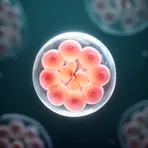
A small cell formed when a fertilized egg divides in early development
 1
9.9
1
9.9
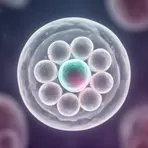
A cell in a very early embryo that has not yet become a specific tissue

A cell in an early embryo that can grow into a specific part of the body
Surface Forms
Morphology
The meaning 'a cell that forms part of an embryo' is directly and transparently derived from combining 'embryonic' (relating to an embryo) with 'cell' (a microscopic living unit). This adjective+noun composition is a regular, compositional pattern found across languages, so a B1 learner who knows both constituents will readily infer the MWE meaning.
Etymology
The compound noun embryonic cell literally names a cell from an embryo, a very small, first form of life. Because these cells act like building blocks that can change and become many kinds of body tissue, the phrase means a cell in 'early development' that can grow into different parts of the body.