

blastomere


 1
9.9
1
9.9
- noun
- /ˈblæstəˌmɪr/
- Specialized
- Thus, the genome was not diminished, but rather reproduced during cell division. (Roux's half-embryos were later interpreted to result from the inhibitory effect of the dead blastomere.)
- blastomere separation
- a blastomere
- human blastomeres
Examples
-
Blastomere separation of embryos beyond the 2- to 16-cell stage (depending on species) was noninformative for testing genomic potential because the cells had too little cytoplasm.
Academic text (1999) -
Each blastomere can differentiate into various cell types during early development.
-
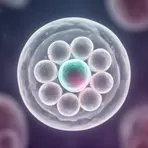
A blastomere is a cell formed during the early stages of an embryo's development.
-
Researchers study how each blastomere can contribute to the formation of different tissues.
Synonyms
 1
4.6
1
4.6
A cell in an embryo during early growth
 1
9.9
1
9.9
A cell in a very early embryo that has not yet become a specific tissue
Surface Forms
Morphology
blastomere = blasto + mere
A technical formation from Greek combining forms (blasto- + -mere) used in biology; the elements are not productive standalone English words and the meaning is not derivable by a typical B1 learner.
Etymology
The word blastomere comes from Greek parts blasto- meaning 'sprout' or 'bud' and -mere meaning 'part'. So a blastomere is a 'sprout-part', a tiny cell made when a fertilized egg splits, which is why it is one of the first cells in the early embryo.