
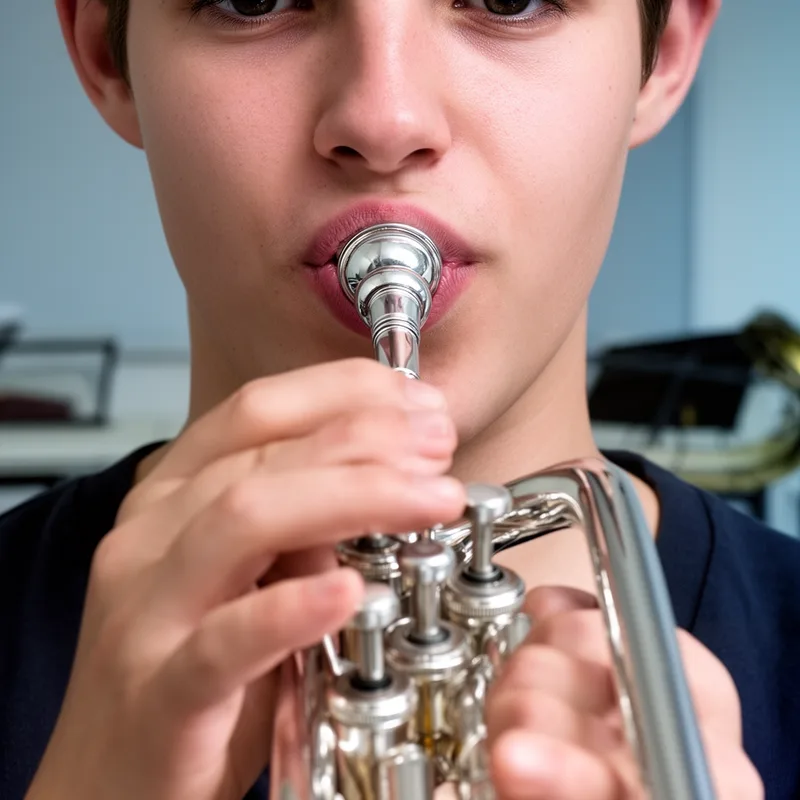
embouchure


 1
9.9
1
9.9
- noun
- /ˌɑːmˈbuːʃər/
- Specialized
- Elementary band teacher Donna Humphreys (Metcalf School, Normal, Illinois) has helped these students by teaching them to recognize what the embouchure feels like for various overtones.
- correct embouchure
- form a flute embouchure
Examples
-
For example, a fifth grader who starts playing the clarinet may not use an appropriate embouchure and will compensate as well as he or she can.
Academic text (2005) -
I set up my music stand and lesson book, held the instrument, formed my embouchure in the way my teacher had demonstrated, reviewed the three fingerings I was taught, and started to blow.
Academic text (2006) -
Now, Joey has a slight embouchure problem.
-
Any student who has had to change an embouchure in college understands and has experienced this pain.
Academic text (2005) -
Now compress your lips to create your embouchure... enough for the tip of your little finger.
-
Complete the steps to form a flute embouchure and play several notes on the flute head joint.
Academic text (2015) -
If the "triangle of condensation" is present, the student has formed the embouchure correctly and should repeat the exercise a number of times to solidify the learning.
Academic text (2015) -
If the "triangle of condensation" is not present, the student (with the assistance of the teacher) should review the steps to form a correct flute embouchure and try again.
Academic text (2015) -
The first thing the new teacher will probably try to do, after making sure the reed is adjusted correctly and the instrument is no longer leaking, is teach a correct embouchure, which can be very painful and perhaps ultimately debilitating for the student.
Academic text (2005) -
To produce a clear tone, you must master your embouchure while playing the trumpet.
Synonyms
 1
4.6
1
4.6
How the lips and tongue move to make speech sounds
Surface Forms
Etymology
Embouchure comes from the French parts em- 'in' and bouche 'mouth', which gives the image of the mouth itself. So an embouchure is also the way a player shapes and uses their mouth and lips to make the right sound on a wind instrument.