

efferent


 1
9.9
1
9.9
- adjective
- /ˈɛfərənt/
- Specialized
- Afferent and efferent nerve pathways move into and out of the spinal cord.
- efferent nerves
- efferent fibers
- efferent activity
Examples
-
Efferent nerve fibers coming from the brainstem have terminals that synapse directly on the outer hair cell.
Academic text (1998) -
I hope that you are finally clear on the difference between afferent and efferent nerves.
Fiction book (1994) -
The content of the efferent copy is not itself conscious.
Academic text (1999) -
And I do know the difference between afferent and efferent.
Fiction book (1994) -
And we talked about some efferent nerve endings on the hair cells and the nerve fibers.
-
You do see it in lower vertebrates, but in mammalian systems the auditory hair cells get an efferent innervation.
-
Importantly, afferent information flow is ascending hierarchical, and efferent information flow is descending hierarchical, as originally proposed by Luria (1973).
Academic text (2008) -
The efferent nerves carry signals away from the brain to muscles, allowing movement.
-
In the human body, efferent pathways transmit commands that result in actions like walking.
-
When the brain sends a message to the heart to beat faster, it uses efferent signals.
Synonyms

To send signals from the brain and spinal cord to muscles to make them move
Antonyms

Compounds
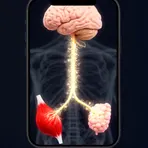
- Specialized
A nerve that carries signals from the brain or spinal cord to muscles and glands
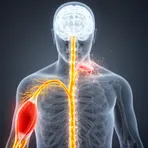
- Specialized
A nerve that sends signals from the brain and spinal cord to muscles or glands
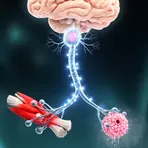
- Specialized
Nerve cell that carries signals from the brain or spinal cord to muscles and glands
Surface Forms
Morphology
efferent = ef + fer + ent
Formed from Latin combining elements (ef- + fer + -ent) that are not recognizable as standalone English words to an average B1 learner, and the term is technical.
Etymology
Efferent comes from the Latin parts ex- meaning 'out' and ferre meaning 'to carry'. That's why, as an adjective, efferent describes nerves or signals that carry information away from the brain or spinal cord.