

ecoregion


 1
6.2
1
6.2
- noun
- /ˌiːkoʊˈriːdʒən/
- Specialized
- In order to protect wildlife, scientists study each ecoregion to understand its unique climate, plants, and animals.
- ecoregion map
- marine ecoregions
- ecoregion delineation
Examples
-
Conservation efforts must focus on the most threatened ecoregions to preserve biodiversity across the planet.
-
The Bolivian Yungas ecoregion includes habitat ranging from low-altitude moist forest to high-altitude cloud forest.
Academic text (1997) -
The colors of the bars correspond with the ecoregion condition in Figure 1.
Academic text (2011) -
Although there is catch remaining in these six ecoregions, it is much lower than in the past.
Academic text (2011) -
However, there is not enough information for firm estimates of condition in these ecoregions.
Academic text (2011) -
The erosion of regional agricultural viability within the ecoregion helped bring about land change.
Academic text (2012) -
We then identified published regional classification systems to be used as a baseline for ecoregion boundaries.
Academic text (2001) -
Data and consultations from regional experts were also important for final ecoregion delineations.
Academic text (2001) -
Maps of freshwater and marine ecoregions are similarly needed for conservation planning.
Academic text (2001) -
The Bolivian Yungas ecoregion includes diverse habitats, ranging from low-altitude moist forests to high-altitude cloud forests.
Synonyms
 977
2.0
977
2.0
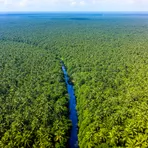
A large area of land with similar features like climate or plants
 2
6.9
2
6.9
A large natural area where similar plants and animals live under a certain climate

An area of land and water that has its own types of plants and animals
How Big

Surface Forms
Morphology
Etymology
The word ecoregion combines eco-, from a Greek word meaning 'home', and region, meaning 'area'. So an ecoregion is like a natural 'home' or 'area' where the climate, plants, and animals live together, and you can see the same eco- in ecology and ecosystem.