
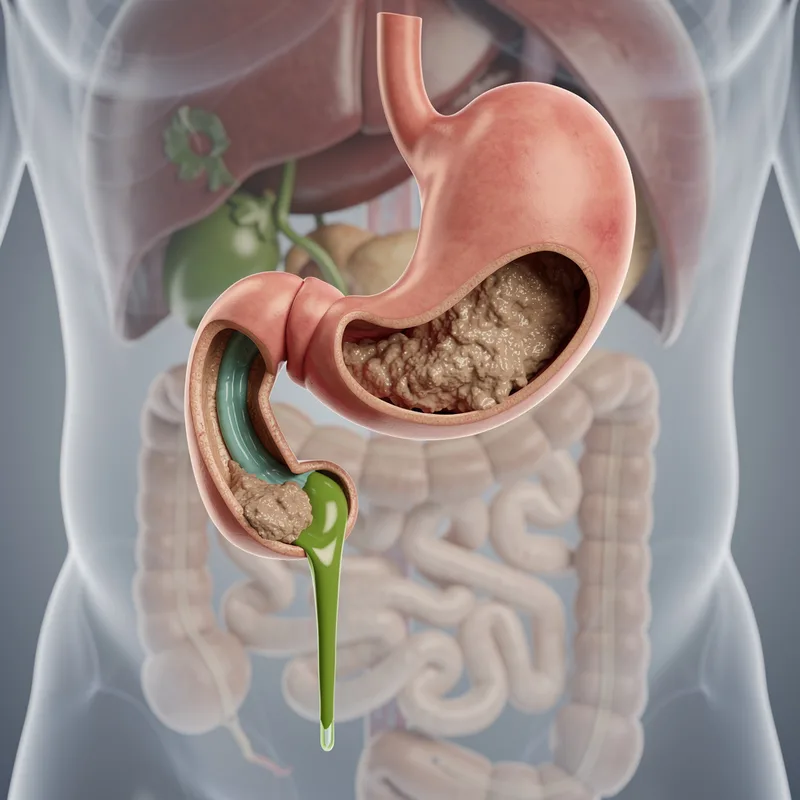
duodenum
 4
7.0
4
7.0

- noun
- /ˌduːəˈdiːnəm/
- Specialized
- and told me that I had a perforation of the duodenum.
- duodenum and jejunum
- duodenum and ileum
- depth in the duodenum
Examples
-
Ryan's x-ray film shows undissolved tablets in the upper part of the duodenum, but none in the stomach.
Academic text (2007) -
In addition to the luminal content from the stomach, the duodenum receives 0.6-1.0 L of bile per day through the common bile duct.
Academic text (2016) -
Vitamin B-12 is not absorbed in the small intestine, but in the duodenum.
-
The gall bladder duct leads to the duodenum.
-
In humans, it reaches 6-7 m in length and consists of the duodenum, jejunum, and ileum in descending order.
Academic text (2016) -
Partial dislocation into the duodenum caused endoprosthesis dysfunction in one patient (Table II).
Academic text (1992) -
During endoscopy, biopsy specimens of the stomach and duodenum are obtained, and the diagnosis of H. pylori can be made by several methods:
Academic text (2005) -
Of the 1000 mg average daily calcium intake, about 100-250 mg is absorbed from the duodenum and upper jejunum.
Academic text (2002) -
A barium study via the Ryles tube revealed antral ulcers with strictures in the adjacent pylorus and duodenum.
Academic text (2007) -
The head of the pancreas is surrounded by the duodenum, the first segment of the small intestine.
How Long

Surface Forms
Etymology
Duodenum comes from a Latin word meaning 'twelve' because people long ago measured it as about 'twelve' finger-widths, like a dozen, and that's an easy picture to remember. So the name points to the short first part of the small intestine right after the stomach.