
domestic help
 1
2.6
1
2.6

- noun
- /dəˈmɛstɪk hɛlp/
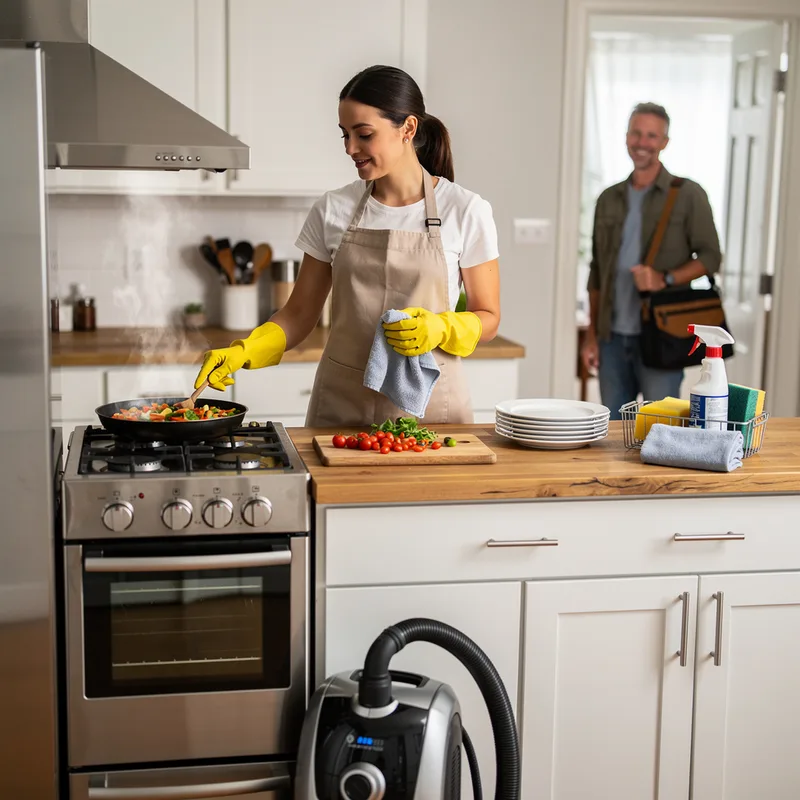
- When they decided to hire domestic help, they wanted someone experienced in cooking and cleaning.
Examples
-
Although women in all social strata face conflicts between the demands of their domestic roles and their work obligations, women who can hire domestic help and possess valuable skills and social contacts enter the better-remunerated formal segments of the job market more easily.
Academic text (1999) -
Camelia's rejection of her abusive marital relationship leads her to rebel against her upper middle-class employer, for whom she works as domestic help.
Academic text (2005) -
The only jobs available to most Black women were as domestic help.
Blog text (18) -
Even in the cities, the most common employment for former slaves was as domestic help, and women supplied most of this work.
Academic text (2002) -
A possible explanation is that full-time domestic help is more easily available in Singapore.
Academic text (1992) -
I lived overseas for a number of years (two of them in Asia) and employed domestic help in each country.
Blog text (27) -
Some full-time domestic help was an almost universal feature of even lower-middle-class Victorian households.
Academic text (1993) -
Hong Kong people get cheap domestic help, and Filipinas and Indonesian women earn salaries that are small fortunes in their destitute homelands.
Blog text (27) -
Many families rely on domestic help to manage household chores like cleaning and cooking.
-
Finding reliable domestic help can be challenging, especially in busy urban areas.
Synonyms
 422
1.0
422
1.0
A person who works in someone's home doing jobs like cooking and cleaning
 264
1.0
264
1.0
A woman paid to clean and cook in another person's home
 161
3.7
161
3.7
A man who manages the staff in a large house and serves meals
 136
1.0
136
1.0
A person hired to do work in a home or restaurant
 110
1.1
110
1.1
A person who manages household chores and keeps the home clean
 51
1.0
51
1.0
A person who cleans houses or offices as their job
 27
1.0
27
1.0
A woman who cleans houses or offices for pay
 14
5.8
14
5.8
A person who works in a home doing cleaning and cooking
 11
7.3
11
7.3
A young man who does cleaning, serving, and errands in a private home
 8
2.4
8
2.4
A woman paid to clean and do other jobs in a home
 7
3.0
7
3.0
People who are paid to do house or farm work
 7
8.9
7
8.9
A man who works in a large house, greeting visitors and serving meals
 7
3.5
7
3.5
A young woman who works in a house to help with chores
 6
1.3
6
1.3
A woman who is paid to clean houses or offices regularly
 4
9.9
4
9.9
A kitchen worker who does dirty, simple jobs like washing dishes
 3
8.6
3
8.6
A woman who works as a servant to help another woman get dressed and look tidy
 3
7.3
3
7.3
A woman who washes and irons clothes for other people
 3
7.1
3
7.1
A woman who works in a home doing cleaning and cooking
 1
3.2
1
3.2
A woman who helps cook and clean in the kitchen of a large house
 1
2.3
1
2.3
A person who works in a home doing cleaning, cooking and other daily tasks
 1
1.9
1
1.9
A person who cleans homes for money
 1
5.1
1
5.1
A girl or young woman who works in a home doing chores


 1
9.9
1
9.9
A woman who works in a home cleaning and serving guests in the front rooms
 1
9.9
1
9.9
A woman who looks after children and helps with housework

A person who cleans, cooks, or does other work in a home

A person who helps older or disabled people with housework and shopping at home

A woman servant who takes care of the wine and plates in a large house

A man who works in a home to serve and help people

A person who washes dishes after a meal

A servant who works in a lord's home doing daily chores in medieval times
How Professional

Surface Forms
Morphology
The meaning 'a person employed to perform household chores' is directly and transparently derived from combining 'domestic' (related to home/household) with 'help' (a person who assists or performs tasks). This adjectival + noun composition is a common, compositional pattern found across many languages, so a B1 learner who knows both constituents would readily infer the MWE meaning.
Etymology
Domestic help comes from a simple picture: domestic means 'home' and help means 'someone who helps' around the house, like cleaning or cooking. So, the phrase came to mean a person hired to do housework and assist in the home.