
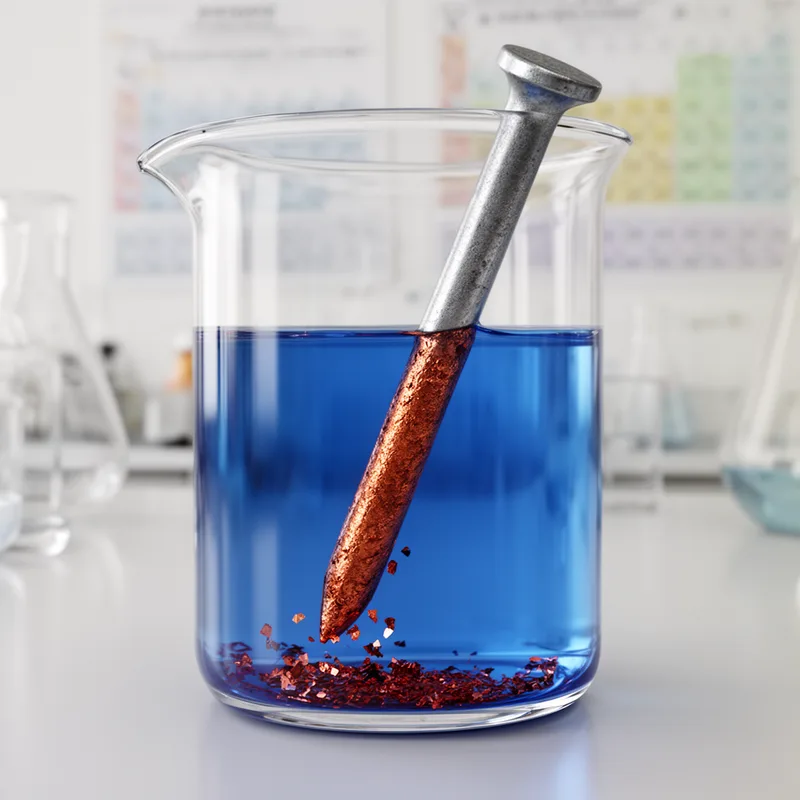
displacement reaction


 1
6.0
1
6.0
- noun
- /dɪsˈpleɪsmənt riˈækʃən/
- Specialized
- In a displacement reaction, a more reactive metal replaces a less reactive metal.
Examples
-
In a displacement reaction, zinc metal replaces copper from copper sulfate solution.
-
A classic displacement reaction is when iron nails are placed in copper sulfate solution and copper is deposited.
-
The demonstration of a displacement reaction is a common experiment in high school chemistry.
-
A displacement reaction occurs when zinc displaces copper from copper sulfate.
-
In a displacement reaction, zinc displaces copper from copper(II) sulfate, forming zinc sulfate.
-
During a displacement reaction, a more reactive metal, like magnesium, can replace a less reactive metal in a compound.
-
When chlorine gas is bubbled through a solution of sodium bromide, a displacement reaction occurs, producing sodium chloride and bromine.
Synonyms
 1
6.3
1
6.3
One element pushes another out of a compound, making the other element free
Antonyms

Surface Forms
Morphology
The term is a straightforward compound of 'displacement' (the act of displacing) and 'reaction' (a chemical process), so its basic meaning — a reaction in which something is displaced — is directly derivable from the parts. This naming pattern is common in scientific terminology and across languages, so a learner who knows both constituents can infer it denotes a reaction where one element displaces another, even if detailed mechanistic knowledge requires subject-specific study.
Etymology
The term displacement reaction comes from the simple image of one element 'pushing out' another from a compound. For example, a stronger metal like zinc 'takes the place' of copper in a solution, so the name means a reaction where one element replaces another.