
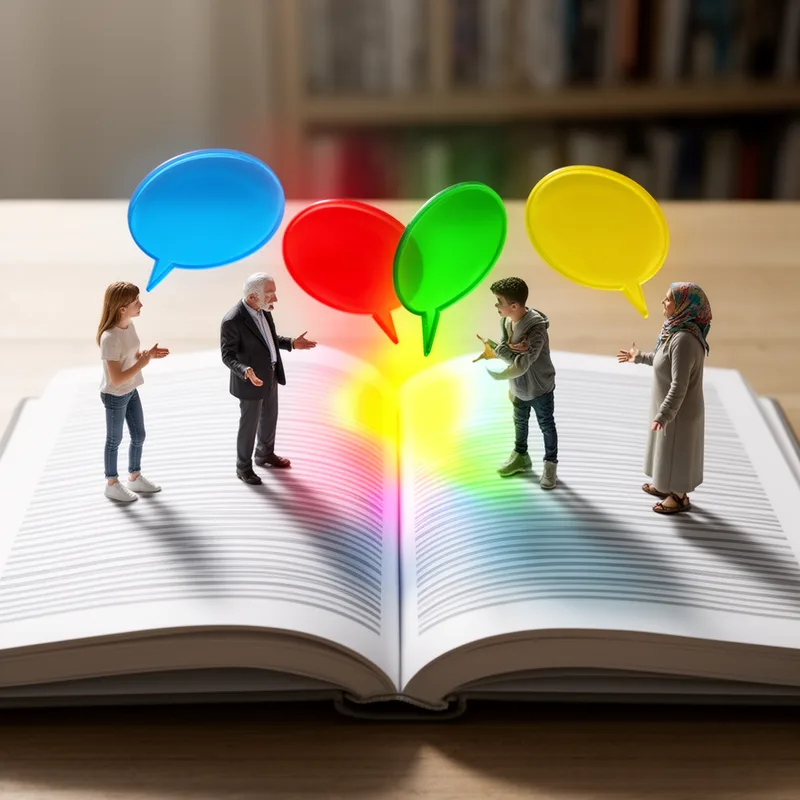
dialogism
- noun
- /ˈdaɪəˌlɒɪɡɪzəm/
- Jargon
- Subjectivity for Bakhtin is a dialogic relation, and in dialogism, the "very capacity to have consciousness" is based on "otherness."
- theory of dialogism
- concept of dialogism
- dialogism or intertextuality
Examples
-
In line with Bakhtin's (1981) description of dialogism, students appropriated others' understandings to extend their own knowledge.
Academic text (2013) -
"Discourse in the Novel" presents Bakhtin's most detailed exposition on dialogism and heteroglossia.
Academic text (1998) -
The state and society are not in direct opposition as long as this dialogism continues.
Academic text (2009) -
A significant factor is Bakhtin's concept of dialogism.
Academic text (2003) -
My last piece of evidence indicates another sort of dialogism, namely, intertextuality.
Academic text (2001) -
Thus, dialogism becomes not only a linguistic exchange but also an interactive drama between perceiver and perceived.
Academic text (1998) -
Bakhtin does, in fact, emphasize this inner dialogism in Tolstoy.
Academic text (1991) -
What Bakhtin's writings on the self add to his linguistic conception of dialogism is the fundamental role of perception.
Academic text (1998) -
The overall effect is thus one of dialogism, not monologism, achieved by counterpointing concepts rather than idiolects:
Academic text (1991) -
Literary critics often analyze dialogism to uncover the multiple voices and perspectives present in a novel's narrative.
Synonyms

A situation in which a text has different voices and points of view

Many different voices in a text or situation that show different views
How Polyphonic


Surface Forms
Morphology
dialogism = dialogue (semi-transparent) = dialogue + ism
Formed by a straightforward attachment of '-ism' to 'dialogue', but the specialized literary-theory meaning is not fully obvious to an average learner.
Etymology
The word dialogism comes from dialogue, which comes from the Greek parts dia- 'through' and logos 'speech'. So dialogism means a text or work where different voices 'talk' to each other and change the meaning.