
delocalization
- noun
- /ˌdiːloʊkəlaɪˈzeɪʃən/
- Specialized
 :
deslocalización
:
deslocalización
- However, near resonance—that is, when the energies of both independent levels coincide—the interaction between bands produces a repulsion and anticrossing between levels as well as a delocalization of the electron in the two bands.
- delocalization of the electron
Examples
-
The delocalization of electrons in a conjugated system helps enhance the conductivity of organic materials.
-
The delocalization promotes much easier intrachain charge transport, although interchain transport is still required for the usual size range of devices made using polymer semiconductors.
Academic text (2006) -
I'm talking about delocalization to stabilize.
-
The C2-C3 double bond was known to be responsible for electron delocalization from ring B, and it increases the radical scavenging activity.
Academic text (2014) -
Anticrossing, mixing, and field-induced delocalization—phenomena essential to transport along the growth axis—have already been observed in GaAs-AlAs superlattices.
Academic text (1994) -
The overlap of the p z orbitals (red and blue) of neighboring carbon atoms allows the delocalization of those electrons into p orbitals along the polymer backbone.
Academic text (2006) -
Electron delocalization in benzene allows the electrons to be shared across all six carbon atoms, contributing to its stability.
-
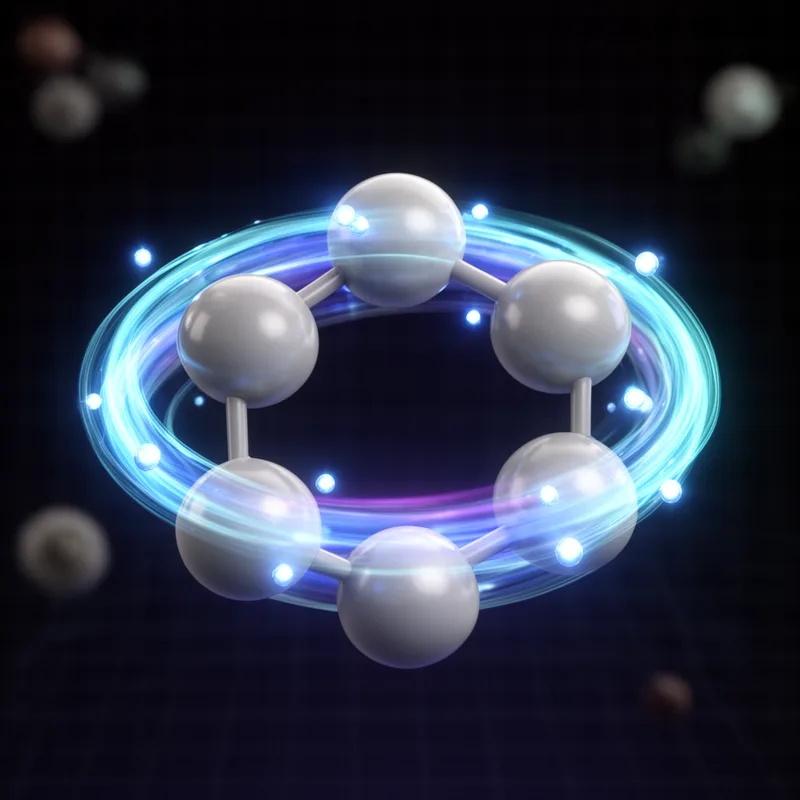
In chemistry, delocalization describes how electrons are spread over multiple atoms rather than being localized to a single atom.
Antonyms

How Delocalized
- Specialized

- Specialized
 1
6.6
1
6.6

Surface Forms
Morphology
delocalization = delocalize (semi-transparent) = de + local + ize + ation
Morphologically it is a nominalization of 'delocalize' by adding '-ation'.
Etymology
Delocalization breaks into de- 'away' and local 'place', the same root as location, so it means 'not limited to one place'. In chemistry and physics this describes electrons that are spread over several atoms instead of staying in one spot, which helps explain stability and the ability to conduct electricity.