
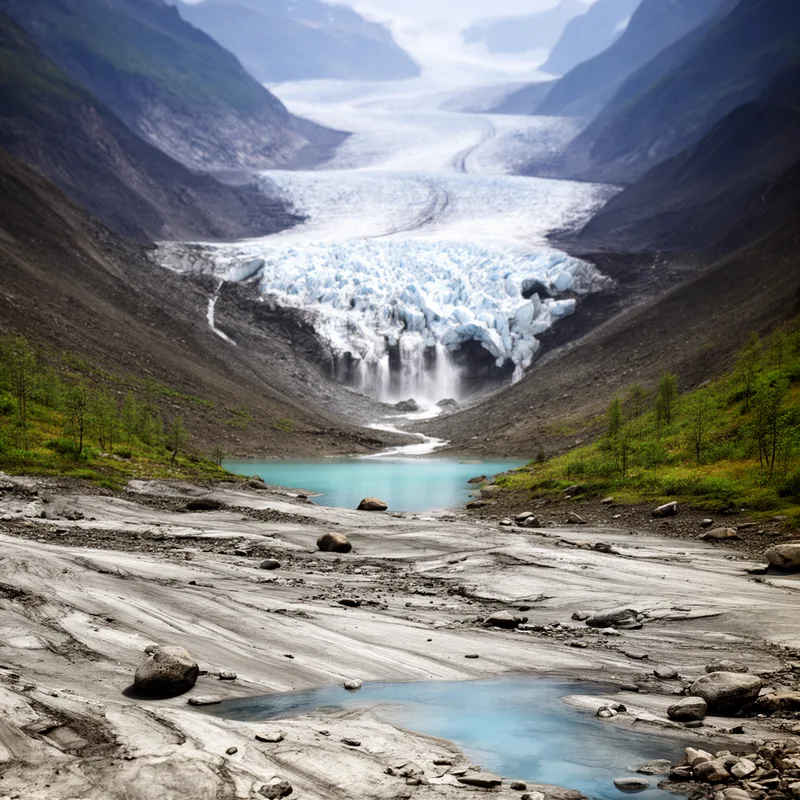
deglaciation


 1
7.9
1
7.9
- noun
- /dɪˌɡleɪʃiˈeɪʃən/
- Specialized
- Scientists study deglaciation to understand its impact on global sea levels and climate change.
- years of deglaciation
Examples
-
Here we present a statistical test of the orbital forcing hypothesis, focusing on the rapid deglaciation events known as terminations.
Blog text (29) -
The chemistry of lakes continues to change for the next several centuries after deglaciation, and some of the more dramatic and ecologically important transformations do not begin until this time period.
Academic text (2007) -
It is the most likely trigger for eventual deglaciation, and we cannot simply ignore this.
Blog text (29) -
In this section, we discuss processes that typically occur in the five years following deglaciation (figure 2a).
Academic text (2007) -
This confirms that CO2 is not the forcing that initially drives the climatic system during a deglaciation.
Blog text (23) -
During the first century and a half after deglaciation, there is a steady increase in lake water DOC and a gradual, though site-specific, rise in N availability (Engstrom et al. 2000).
Academic text (2007) -
Rather, deglaciation is probably initiated by some insolation forcing (1, 31, 32), which influences first the temperature change in Antarctica (and possibly in part of the Southern Hemisphere) and then the CO2.
Blog text (23) -
Seawater d18O reconstructions north of the equator suggest fresher surface conditions during the last glacial and track the northern high-latitude climate change during the last deglaciation.
Blog text (29) -
In most lakes, alkalinity and pH declines do not begin until about 200 years after deglaciation and therefore are barely evident in lakes occupying the low-elevation forelands in Glacier Bay proper.
Academic text (2007) -
The process of deglaciation has significantly altered the landscape of the region over thousands of years.
Synonyms
 12
2.0
12
2.0
A period when snow and ice melt because the weather is warmer
 2
3.5
2
3.5
Ice changing into water in large areas like glaciers and sea ice
 1
9.5
1
9.5
Loss of ice from a glacier surface by melting or evaporation
Antonyms
Surface Forms
Morphology
deglaciation = glaciation (semi-transparent) = de + glaci + ation
For learners who know 'glaciation', adding 'de-' gives the regular meaning of reversal or removal, i.e. the loss or retreat of glaciation.
Etymology
The word deglaciation starts with de- meaning 'remove' or 'away', and the rest comes from glacier meaning 'ice'. So deglaciation is like 'ice being taken away', the melting and retreat of glaciers.