
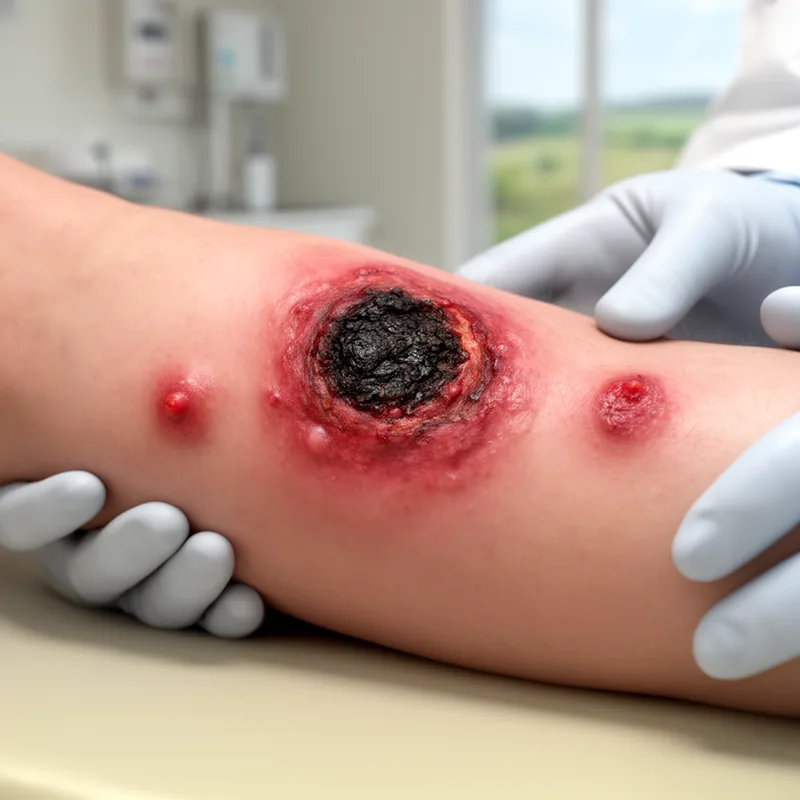
cutaneous anthrax


 1
9.2
1
9.2
- noun
- /kjuˈteɪniəs ˈænθræks/
- Specialized
- Table 2. Results of the negative binomial regression model examining risk factors for human cutaneous anthrax, Georgia TABLE #
- human cutaneous anthrax
Examples
-
Characteristics of human cutaneous anthrax patients, Georgia, 2010-2012 TABLE #
Academic text (2014) -
We assessed the occurrence of human cutaneous anthrax in Georgia during 2010–2012 by examining demographic and spatial characteristics of reported cases.
Academic text (2014) -
The doctor diagnosed him with cutaneous anthrax, which caused painful lesions on his skin.
-
During the outbreak, cases of cutaneous anthrax were monitored closely by health officials.
-
Patients with cutaneous anthrax may experience symptoms such as fever and severe fatigue.
Synonyms
 80
6.9
80
6.9
A serious disease that mainly affects animals like cows and sheep and can also infect people
How Severe
- Specialized
1
9.2

- Specialized
Surface Forms
Morphology
The phrase is a regular adjective+noun combination where 'cutaneous' means affecting the skin and 'anthrax' is a disease, so the meaning — the skin form of anthrax — is directly derivable from the constituents. This compositional medical naming pattern is cross-linguistically common and follows standard English formation, making it transparent to learners who know both words.
Etymology
The medical name cutaneous anthrax comes from two words: cutaneous, meaning 'skin', and anthrax, meaning 'charcoal', because the infection often makes a dark, charcoal-like sore on the skin. So, the name refers to the form of anthrax that affects the skin.