

to cut into
 3
4.5
3
4.5

- phrasal verb
- /kʌt ˈɪntu/
- To prepare the garden, they decided to cut into the ground and loosen the dirt.
Examples
-
She carefully cut into the earth with a spade to create space for the new plants.
-
Just follow the paths that they cut into the earth right back to their door.
Blog text (27) -
The convoy passes along a road cut into the side of the ridge.
Fiction book (1996) -
At planting, seed is slotted into a groove cut into the soil.
Academic text (2003) -
In this new technique, grooves are cut into the tension face of concrete beams to be subsequently filled with an epoxy resin.
Academic text (2017) -
Bwindi Impenetrable National Park encompasses some 130 square miles of wet, rugged hills cut into steep ravines by cold rushing streams.
Academic text (2003) -
The farmer used a plow to cut into the soil for planting the seeds.
Synonyms
 912
1.0
912
1.0
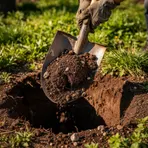
To move earth with a tool to make a hole
 20
7.2
20
7.2
To make a deep cut or hole in something with a sharp object
 14
3.2
14
3.2
Remove something that is under the ground or snow using a shovel
 5
3.4
5
3.4
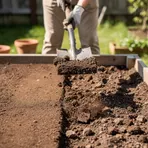
Dig and loosen soil to prepare it for planting
 5
7.4
5
7.4
To make a deep cut or groove in a surface by scraping
 2
3.4
2
3.4
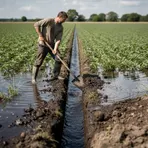
To dig a long, narrow trench to carry water away
 1
6.3
1
6.3
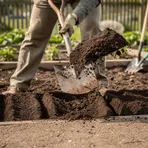
To dig and loosen soil, for example with a spade

To cut deep into a surface to make patterns or letters
How Deep

Surface Forms
Morphology
The meaning 'to divide something into smaller pieces by cutting' is directly and transparently derived from combining 'cut' (to slice/separate) with 'into' (indicating movement/resulting partition inside something). This is a common compositional verb + preposition pattern found across languages, so a B1 learner who knows both constituents will readily infer the meaning.
Etymology
Cut into comes from working the ground. Imagine a spade or plow blade going down and making a clean line as it lifts and turns the soil — it literally cuts into the earth to loosen it. So, the phrase means 'to turn up or remove earth'.