
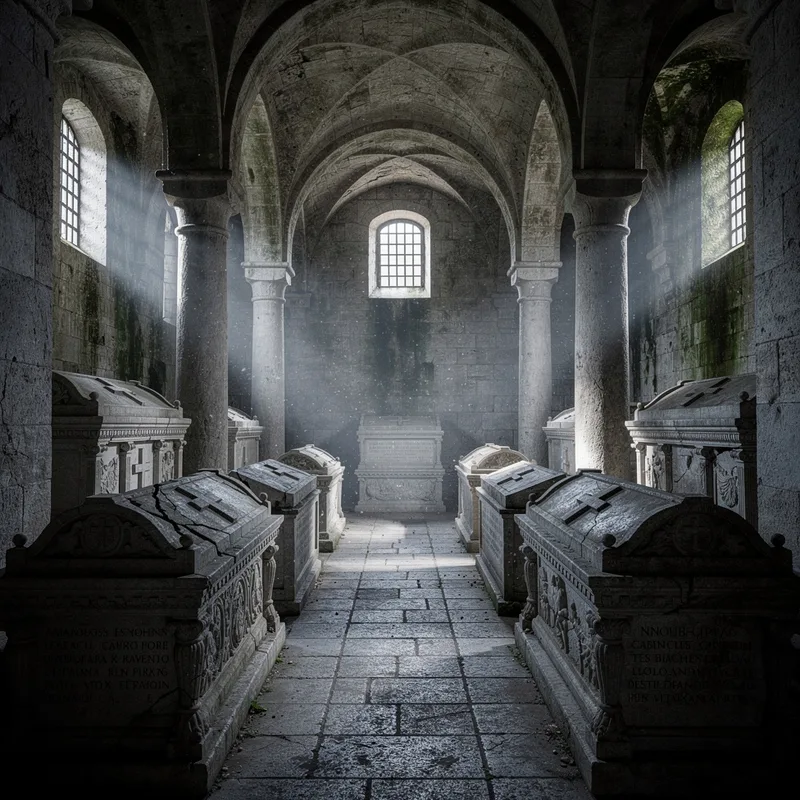
crypt
 51
7.6
51
7.6

- noun
- /krɪpt/
- Visitors can explore the crypt, which holds the remains of many historical figures.
- a deep crypt
Loading YouTube…
Watch on YouTubeAnd they put the women and children in a crypt with all the dead people.
- And they put the women and children in a crypt with all the dead people.
- It's actually fighting them till dawn and keeping them out of their crypt.
Examples
-
Beneath many of Italy's cathedrals and monasteries are crypts that hold mummies.
Academic text (2003) -
That is why so much music of the cinquecento was played in crypts and catacombs.
-
Okay, looks like we're in some kind of crypt.
-
Or a crypt in the basement?
-
You know the legend written on the wall of the crypt?
-
Confused, Haplo looked from his own empty crypt to one located next to his.
Fiction book (1991) -
On either side of them are two crypts, enough for four burial vaults.
Fiction book (1994) -
Until the nineteenth century, Cubans buried their dead in stone crypts beneath churches.
Academic text (2002) -
The archaeologists discovered ancient artifacts in the crypt beneath the old church.
-
Local legends say that the crypt is haunted by the spirits of those buried there.
Synonyms
 235
3.0
235
3.0
A large stone building or underground room where people put a dead person
 16
9.1
16
9.1
An underground place with tunnels where people are buried
 15
6.9
15
6.9
An underground room for holding the bodies of several people
 5
9.9
5
9.9
A small stone room where a dead person is buried
 4
6.3
4
6.3
A room under the ground that holds a dead body
 1
7.9
1
7.9
An underground space for burying a coffin that protects it and holds family coffins
A room under a church used for burials or quiet prayer

A building near a church where people's bones are kept
How Big

Surface Forms
Etymology
The word crypt comes from an old Greek word kryptos meaning 'hidden', and you can see the same root in cryptic and encrypt, which also mean 'hidden' or 'secret'. A crypt is a 'hidden' room under a church used for burials, so the origin explains why we call that underground burial place a crypt.