
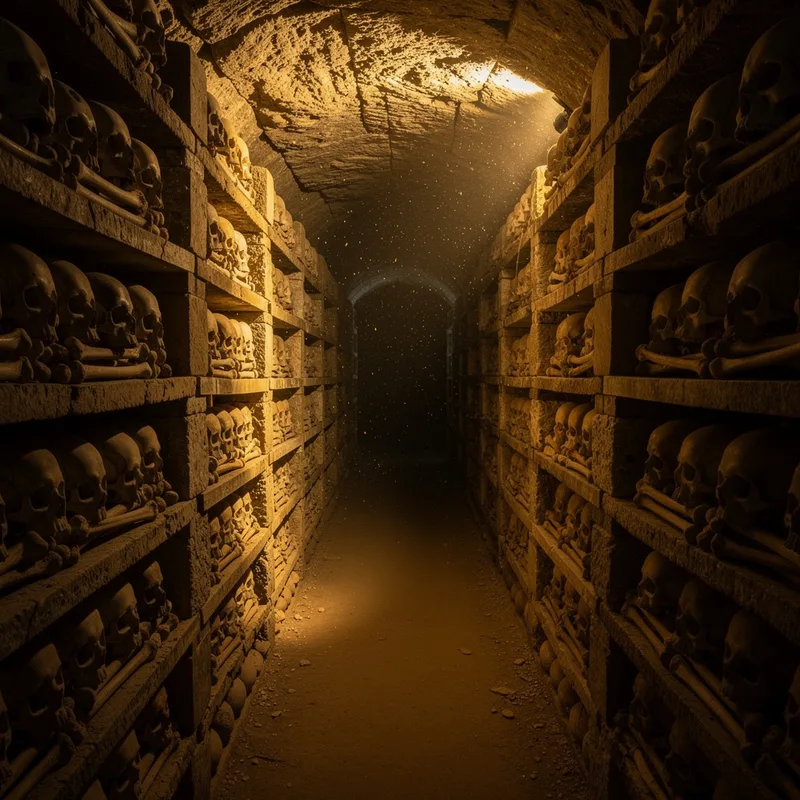
catacomb
 16
9.1
16
9.1

- noun
- /ˈkætəˌkoʊm/
- Christians gradually stopped using catacombs after Christianity became the state religion at the end of the fourth century A.D.
- Christian catacombs
- Jewish catacombs
Loading YouTube…
Watch on YouTubeI was summoned to the Adam and a Mean Heights by no less than Ikure Confas and brought to the Imperial catacombs.
- I was summoned to the Adam and a Mean Heights by no less than Ikure Confas and brought to the Imperial catacombs.
Examples
-
In Rome, subterranean catacombs house both cremation urns and intact remains.
-
Exploring the dark catacombs, we discovered tombs filled with artifacts from centuries past.
-
You can go down to the catacombs and still get lost.
-
We found the entrance to the catacombs.
-
By the 12th century, many catacombs had been forgotten.
Academic text (2008) -
Beyond this passage lie the catacombs of Paris: the exclusive domain of the dead.
Fiction book (1997) -
But scholars have learned much from the catacomb, especially about the occupations and religious practices of Rome's Jewish community.
Academic text (2008) -
I remembered stories the nuns had told us about the catacombs constructed by early Christians.
Fiction book (1994) -
But the undisputed star of the catacombs is Rosalia Lombardo, a seven-year-old girl who died in 1920.
Academic text (2003) -
Many ancient catacombs, such as those in Rome, served as burial sites for early Christians.
Synonyms
 421
2.8
421
2.8
A place where people are buried, often with headstones
 4
9.9
4
9.9
A large old cemetery for a city with many tombs

A large very old burial place near a city with many tombs
How Complex

Surface Forms
Etymology
Catacomb comes from old Greek parts kata- meaning 'down' and kymbe meaning 'hollow' or 'cave', so it originally meant a burial place 'down in the hollow' under the ground.