
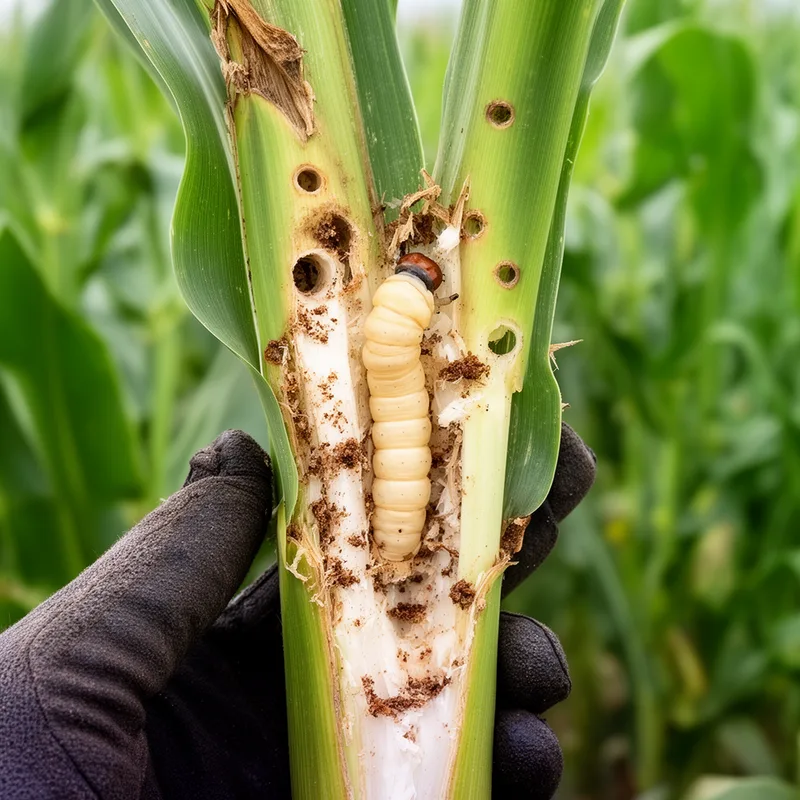
corn borer


 1
7.7
1
7.7
- noun
- /kɔrn ˈbɔrər/
- So here's a little graphic of the the corn borer eating the corn.
- European corn borer
Loading YouTube…
Watch on YouTubeThe protein from the Bacillus thuringiensis crystallizes in the corn borer's gut and the corn borer dies.
- The protein from the Bacillus thuringiensis crystallizes in the corn borer's gut and the corn borer dies.
Examples
-
Grey leaf spot mold was noted throughout the field, as well as an extremely high incidence of European corn borer, which weakened the stalks and reduced yields.
Academic text (1996) -
Testing would be done more frequently for the Mediterranean corn borer than for the European corn borer, which has fewer generations per year.
Academic text (1999) -
Farmers know when that point is reached because experts have calculated that they should use insecticide when, for example, they have a certain number of corn borers per cornstalk on a sampling of plants.
Academic text (1996) -
At harvest, losses from the European corn borer, grey leaf spot mold, and ice damage caused a net yield of 110 dry bushels per acre.
Academic text (1996) -
Among the chief targets of this biotechnological defense is the European corn borer, a moth whose caterpillar stage costs U.S. farmers an estimated $1 billion annually in losses.
Academic text (2002) -
The protein from the Bacillus thuringiensis crystallizes in the corn borer's gut and the corn borer dies.
-
Bt corn contains genes from the bacterium Bacillus thuringiensis so that the plant will produce proteins to protect itself against insect pests such as the European corn borer.
Academic text (2002) -
Farmers must take measures to control the European corn borer, as it can severely damage their crops.
-
To prevent infestation, it's essential to monitor fields for the presence of the corn borer larvae.
-
The corn borer is known for boring into corn stalks, often leading to significant agricultural losses.
Synonyms

A moth whose caterpillars eat and damage corn and other crops
A small moth whose young caterpillars make holes in corn stems and damage crops
A small moth whose caterpillars tunnel into corn stems and damage crops

A small moth whose caterpillars eat corn and harm crops
Surface Forms
Morphology
The compound is transparently compositional: 'borer' denotes an organism that bores/tunnels into plant tissue and 'corn' specifies the host, so a 'corn borer' is predictably an insect that bores into corn. This follows a common noun-noun compounding pattern found across languages, so a B1 learner who knows both constituents should be able to infer the meaning.
Etymology
The noun corn borer comes from the words corn and borer, because the insect 'bores' or makes holes into the plant stems and ears. That's why corn borer means 'an insect that damages corn by making holes'.