
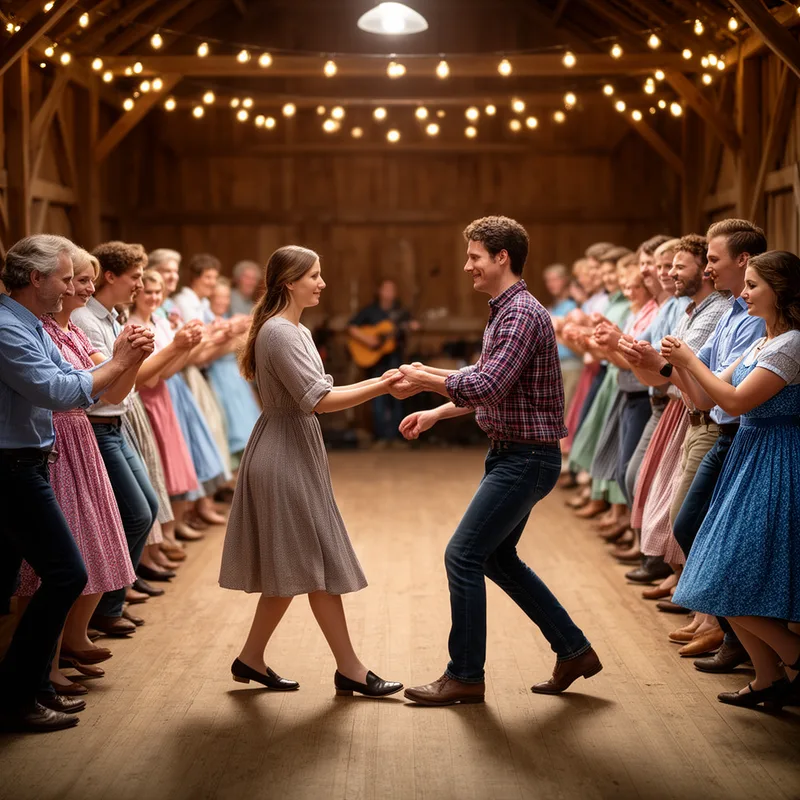
to contra danse
- verb
- /ˈkɒntrə dɑːns/
- US
- She learned how to contra danse during her summer in Vermont.
Examples
-
At the festival, dozens of couples contra dansed joyfully until midnight.
-
Every Saturday night, locals gather in the barn to contra danse together.
-
We will contra danse at the festival this weekend.
-
Have you ever contra danced before?
-
At the neighborhood festival, everyone decided to contra dance to the lively music.
-
She loves to contra dance at the local community center every Saturday evening.
-
I learned to contra dance during a summer workshop, and now I can't stop practicing.
Synonyms

To take part in a lively folk dance with couples in lines

To dance in sets or lines to traditional folk music

To dance in a traditional style from a region
Surface Forms
Morphology
contra + danse
Although the constituents are non‑standard English borrowings, a learner who knows 'contra' (against/opposite) and 'danse' (dance) can infer this refers to a kind of dance involving opposing lines or partners; cross‑linguistic cognates (e.g. Spanish/French forms) support that inference. However, the precise cultural/folk‑dance conventions (sequence of figures, formation) are specialized and not fully predictable from the parts alone, so full understanding requires prior exposure.
Etymology
Contra danse (as a verb) comes from the same French idea: it meant 'opposite dance', or simply to dance while facing another line of people. So to contra danse today means 'to perform this kind of folk dance'.

