

common bog rosemary
- noun
- UK
- You can identify common bog rosemary by its pink, bell-shaped flowers and leathery leaves.
Examples
-
The common bog rosemary thrives in acidic soil.
-
The wetland was filled with common bog rosemary and other rare plants.
-
Scientists studied the impact of climate change on common bog rosemary populations in northern Europe.
-
Have you seen a common bog rosemary in bloom?
-
Scientists studied the impact of climate change on common bog rosemary populations in northern Europe.
-
The wetland was filled with common bog rosemary and other rare plants.
-
You can identify common bog rosemary by its pink, bell-shaped flowers and leathery leaves.
Synonyms

A small evergreen bush with pink or white hanging flowers that grows in acidic wet bogs
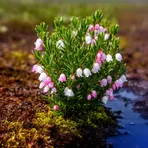
A small shrub that stays green all year and has white or pink flowers in wet acidic bogs

A thin evergreen shrub with small hanging pink or white flowers that grows in wet bogs

A low bog bush from northern Europe and Asia with leaves that smell strong and pleasant, not the cooking herb
Surface Forms
Morphology
The noun phrase is compositionally built: 'rosemary' (a plant) modified by 'bog' (indicating it grows in bogs) and 'common' (indicating it is widespread). A learner who knows the constituent words can readily infer it refers to a rosemary-like shrub that lives in boggy areas, so the meaning is transparently derivable from its parts.
Etymology
Common bog rosemary comes from the plant's look and home. People called it bog rosemary because its needle-like leaves reminded them of kitchen rosemary, and they added common when this was the usual kind found in local bogs. So the name points to a 'plant' that looks like rosemary and lives in wet bogs.

