

to comb out
 1
2.4
1
2.4

- phrasal verb
- /koʊm aʊt/
- I'd left all the towels I had clean on the toilet seat, and a half hour later she emerged, combing out her hair.
- combed out her hair
- comb the tangles out
- combed the knots out
Loading YouTube…
Watch on YouTubeOh my God, Anything you'll have a fella just just comb his bang straight out across his face.
- Oh my God, Anything you'll have a fella just just comb his bang straight out across his face.
- It will change your lower lash game so much because you can actually get underneath here and comb out your lower lashes.
Examples
-
When I watched the video, specifically at the time I was watching the video, I think I was combing out one of my wigs.
-
However, when I tried to comb my plaits out with Nadine's hard brush, every tug hurt enough to make my eyes smart.
Fiction book (2001) -
So like comb your hair out when you go through it.
-
Mother combed out our hair.
Fiction book (1992) -
So the first thing I'm going to do is comb out my hair a little bit and I'm going to part my hair.
-
He combed out his hair.
Fiction book (1995) -
It will change your lower lash game so much because you can actually get underneath here and comb out your lower lashes.
-
They comb out their long hair, leaving strands caught in their combs, then they push their bangs back over their eyes.
Fiction book (1991) -
Laurie vigorously toweled her hair, then combed it out before using the electric hair dryer.
Fiction book (1999) -
She carefully combed out the tangles in her long hair before getting ready for the party.
Synonyms
 77
1.0
77
1.0
To remove knots and smooth hair with a comb
 1
5.3
1
5.3
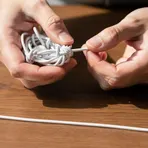
To free something twisted and knotted, like a cord
Antonyms


How Thorough
1
7.1
 1
2.4
1
2.4
Surface Forms
Morphology
The meaning 'to use a comb to untangle, smooth, or neaten hair' is directly derived from combining 'comb' (apply a comb to hair) with the particle 'out' (indicating thoroughness or removal), so a learner who knows those constituent senses can infer the MWE. Although the supplied verb sense of 'comb' (to search) differs, the grooming sense is common and the compositional pattern is cross‑linguistically straightforward, making this transparent to a B1 learner.
Etymology
Comb out comes from using a comb to pull knots and tangles out of hair or wool. You run the comb through slowly to make the hair smooth, so it means 'to untangle or neaten'.