
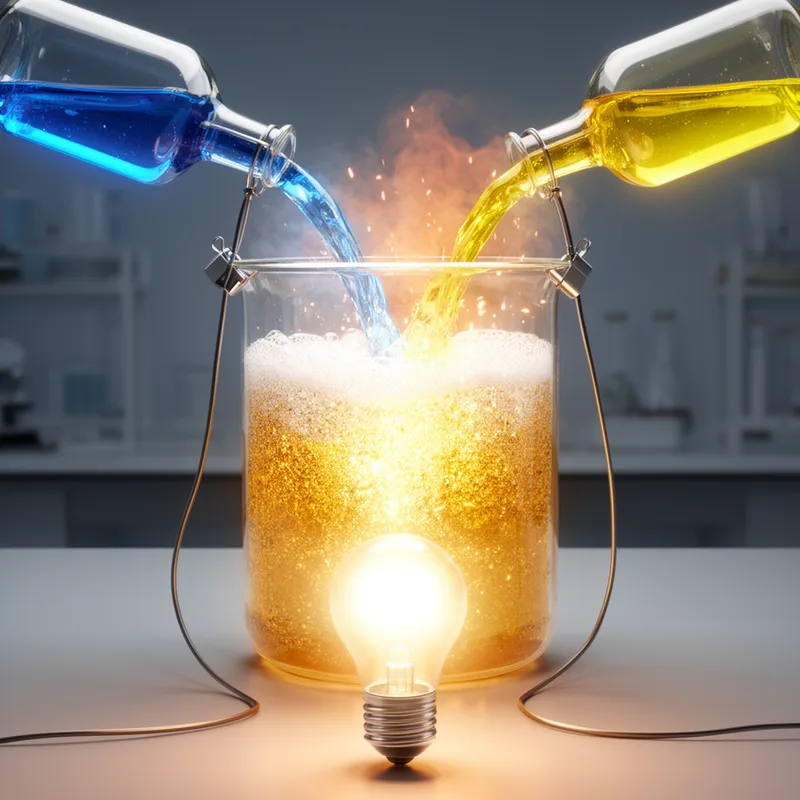
chemical energy
 2
4.0
2
4.0

- noun
- /ˈkɛmɪkəl ˈɛnərdʒi/
- Specialized
- For example, hot vents on Earth's deep ocean floors are sites where hyperthermophilic archaea feed off the supply of chemical energy and are entirely independent of energy from the sun.
- convert chemical energy
- release of chemical energy
- chemical energy in a fuel
Loading YouTube…
Watch on YouTubeSo that's a million times increase from chemical energy.
- So that's a million times increase from chemical energy.
- In fact, this process is actually used by a number of organisms to generate heat instead of chemical energy or ATP.
Examples
-
Derived from a patented vanadium-based redox regenerative fuel cell, VRB's flow batteries convert chemical energy into electrical energy.
Academic text (2005) -
An auto mechanic who visits the class is influential in helping them better understand how their car battery's chemical energy can be transformed in order for a motor to turn, bulbs to light, and wires to heat.
Academic text (2008) -
We may choose not to burn something, and thus the potential chemical energy is not released.
Blog text (16) -
The leaves absorb light, which is converted into chemical energy.
Blog text (24) -
So you take in oxygen and fuel and it gets converted into chemical energy called ATP by the cell.
-
So that's why wood burns, because it has stored chemical energy given to it by the sun.
-
However, biological motors are much more efficient in converting chemical energy into motion than car motors.
Blog text (7) -
Cars convert chemical energy from gasoline into mechanical energy that fires pistons and drives a car forward.
Blog text (7) -
Molecular motors convert a chemical energy known as ATP into physical motion along microscopic tracks.
Blog text (7) -
Plants convert sunlight into chemical energy through the process of photosynthesis.
How Powerful
- Specialized
73
5.9

- Specialized
5
3.8
- Specialized
2
4.0
- Specialized
28
3.7
Surface Forms
Morphology
The meaning 'energy stored in the bonds of chemical compounds' is directly and compositionally derived from 'chemical' (relating to chemicals or chemistry) modifying 'energy' (usable power). This modifier+noun pattern is regular and cross-linguistically common (e.g., Spanish energía química), so a B1 learner who knows both constituents can readily infer the MWE meaning.
Etymology
The term chemical energy gives a picture of tiny parts in a substance holding power like a wound-up spring. When the bonds between those parts break the power is 'released', so the term means the energy 'stored' inside a substance that can come out in a chemical 'reaction'.