

to change course
 41
3.7
41
3.7

- phrasal verb
- Mr. Brook, we're changing course.
- change course quickly
Loading YouTube…
Watch on YouTubeSo we changed course, started heading towards the the objective about one minute out.
- So we changed course, started heading towards the the objective about one minute out.
Examples
-
They've changed course, now headed north, northeast.
-
The ship began to change course, steering away from the shallows.
-
And if you can change course, then do that.
-
Tell him to change course.
-
An enemy control boat has changed course and is heading for our people.
-
Change course to zero-90 degrees for ten minutes!
-
For his sake, for his party's sake and in the national interest, the Chancellor needs to change course and he needs to do so now.
-
His boat suddenly changes course and the two skiers collide, flying onto the ice.
Fiction book (1997) -
Administrations, regardless of their initial ideologies, often change course to adjust to public opinion.
Academic text (2001) -
They changed course.
Synonyms
 94
4.2
94
4.2
To cause something like traffic or a river to go a different way
 47
3.6
47
3.6
To send something along a different path
 8
5.6
8
5.6
To change the direction or main focus of something
 7
8.1
7
8.1
Turn a boat's bow into and across the wind to change direction
 1
9.6
1
9.6
To move a sail or boat quickly from one side to the other when sailing with the wind

To move suddenly from one side of a boat to the other, usually about a sail or boom
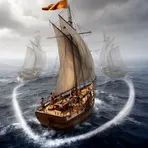
Turn a sailing boat away from the wind by moving the back through the wind, not the front
Antonyms


How Sharp

Surface Forms
Morphology
The meaning 'to alter direction' is directly derivable from combining 'change' (to alter) with 'course' (route or heading); the components compose in a straightforward, literal way. This motion/route construction is cross-linguistically common and follows normal English verb + noun composition, so a B1 learner who knows both words would readily infer the MWE's meaning.
Etymology
The verb change course comes from ships: when a captain turns the wheel the ship moves onto a new course, so people literally change direction. That's why it means 'to alter direction', especially of a vessel.