
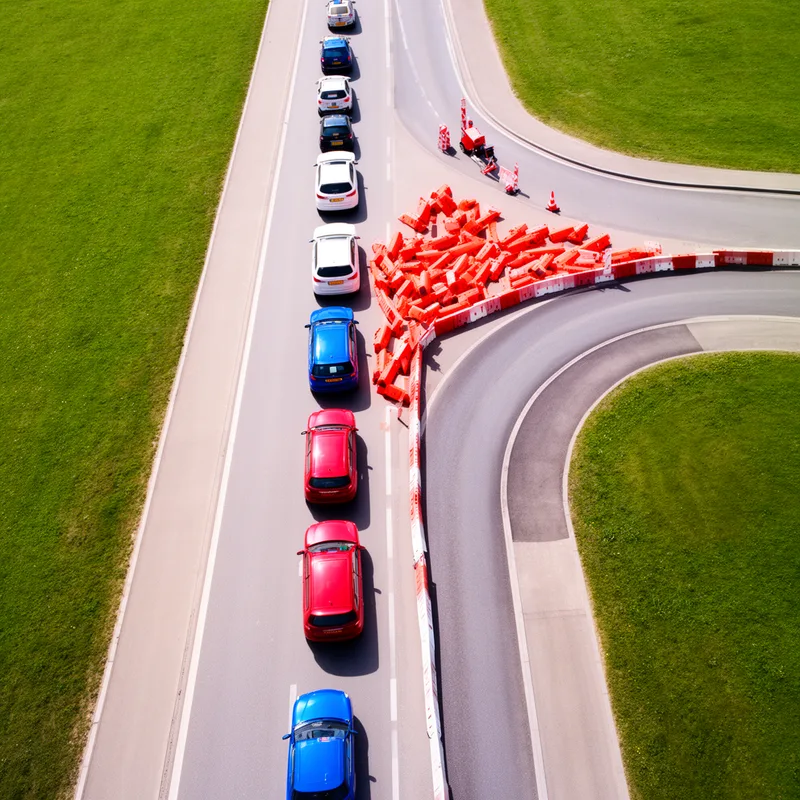
to divert
 94
4.2
94
4.2

- verb
- /dɪˈvɜrt/
- Divert all energy to the armor!
- divert the flow
- divert water
- divert resources
Loading YouTube…
Watch on YouTubeAnd, and how do we divert out of that pattern?
- And, and how do we divert out of that pattern?
- And then on my way home, I was like, Uber, can I please divert you to a toy shop?
- They argued that this front needed to be kept open to divert Allied troops from the Western Front.
- Yeah, the thumbnails pretty much feel the same because whenever we divert from that, we get less clicks, right.
- The mitochondria are not going to be able to deal with the volume and so they're going to divert the excess and turn that into fat.
- The body is going to respond to that fear, even if it's emotional, and that will divert our resources towards defense rather than thriving.
- So a network manager will see, oh, we have congestion over there, let's adjust the link weights so that the traffic will be spread out more or diverted.
- You cannot get distracted or diverted by the, you know, reality show that's going on on the stage right next to you because that's what it is.
- Unfortunately, we were able to divert power such that it did not cause a massive outage in Silicon Valley.
- And it's not that difficult to kind of divert the metabolism from.
Examples
-
To control the Tiber's floods and divert its course.
-
They argued that this front needed to be kept open to divert Allied troops from the Western Front.
-
So you now want me to divert into electricity, do you?
-
Can you divert to a free world destination?
-
Maybe I can divert the missiles.
-
Divert all computer functions to total investigation.
-
Businesses closed, tourists canceled hotel reservations, and vehicles were diverted from the area.
Academic text (2008) -
Major irrigation canals to divert water from the river were first constructed around 200 B.C.
Academic text (1992) -
Approaching the city, the pilot was diverted to a villa on the outskirts of the city.
Fiction book (1994) -
To improve traffic flow, the city decided to divert vehicles to a different route during the construction.
Synonyms
 76
4.6
76
4.6
To turn attention away from a person or thing
 67
3.7
67
3.7
Send people, things, or attention somewhere else to change focus
 33
4.4
33
4.4
To cause something to happen in a different way or direction
 26
3.5
26
3.5
To send something to a particular person or place
 8
5.6
8
5.6
To change the direction or main focus of something
 8
3.8
8
3.8
To guide cars and people so they move safely through an intersection
 7
3.7
7
3.7
To go by a longer route to avoid a blocked road


 1
6.0
1
6.0
To change the course or use of something
Antonyms


How Redirected

Surface Forms
Etymology
Divert comes from the Latin parts dis- 'away' and vertere 'to turn', so it means 'turn away'. That's why to divert something is to change its direction or send it along a different route.