
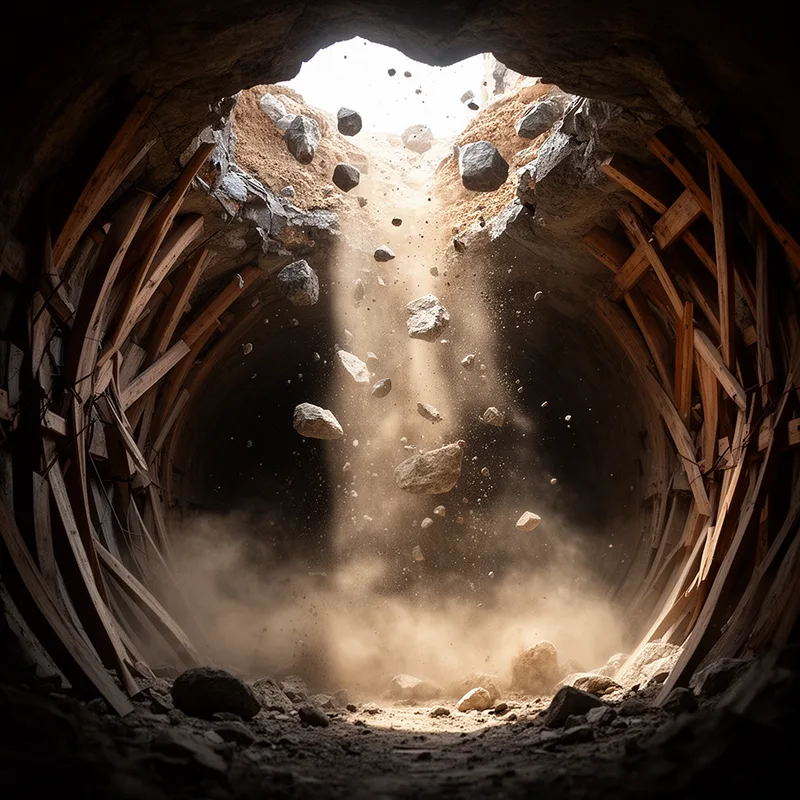
to cave in
 22
3.7
22
3.7

- phrasal verb
- /keɪv ɪn/
- After years of neglect, the mine's entrance finally caved in, blocking access completely.
- roof caved in
- ceiling caved in
- wall caved in
Loading YouTube…
Watch on YouTubeSo the American Heart Association is caving in on low carbohydrate diets.
- So the American Heart Association is caving in on low carbohydrate diets.
- So we can ask, well, why would reality cave in?
- He casting the whole show and my stomach like caved in into my spine and I was just sitting here like wow.
Examples
-
Under the stress of constant deadlines, she felt like her resolve might cave in soon.
-
Apparently due to faulty engineering, the entire building flooded and half the ceiling caved in.
-
Take them from the top, otherwise the whole thing will cave in on us.
-
"Hurry up before the whole thing caves in," he said.
Fiction book (1997) -
Do you want the roof to cave in?
-
I can save the city... but this entire network of tunnels is going to cave in.
-
The entire roof might cave in, and they would be buried alive.
Fiction book (1993) -
As Ray came close, he could see that the house's bottom floor was caved in.
Fiction book (1994) -
The greater part of the roof had caved in and lay on the floor of the second story.
Fiction book (1998) -
The house looked as though at any moment it might cave in, suddenly and soundlessly.
Fiction book (2002)
Synonyms
 ∞
3.5
∞
3.5
To stop being strong and bend or break under pressure
 579
3.9
579
3.9
To fall down suddenly, for example when a person faints or a building breaks
 177
3.4
177
3.4
To break into small pieces or become weaker and collapse
 39
3.5
39
3.5
To collapse inward under pressure
 35
6.7
35
6.7
Collapse inward suddenly because of strong outside pressure
 35
4.2
35
4.2
Break or fail because of pressure
 30
4.4
30
4.4
To collapse inward, as a roof or organization breaking down
 22
3.9
22
3.9
Suddenly fall down because something is weak or hit hard
 5
6.8
5
6.8
To fail completely because of problems with plans or projects
 4
4.0
4
4.0
Start to break into pieces or stop working well

Suddenly fail completely because it is weak or badly built
Antonyms


How Complete
35
6.7
 22
3.7
579
3.9
35
4.2
19
2.8
311
1.0
22
3.7
579
3.9
35
4.2
19
2.8
311
1.0
Surface Forms
Morphology
The meaning 'to yield or submit' is directly derived from combining 'cave' (to give up resistance) with the directional/into-state sense of 'in' — together signalling moving into a state of collapse or submission. This compositional pattern parallels verbs like 'give in' and is likely understandable to a B1 learner who knows the constituent meanings.
Etymology
Cave in comes from the image of a cave or a weak roof suddenly falling down into the space below. That's why it means 'to collapse' or fall down.