

catalyst
 12
4.7
12
4.7

- noun
- /ˈkætəˌlɪst/
- Specialized
- Enzymes serve as catalysts, speeding up chemical reactions in the body without being consumed.
- platinum catalyst
- acid catalyst
- oxidation catalyst
Loading YouTube…
Watch on YouTubeWe're going to learn about catalysts and how they affect kinetics.
- We're going to learn about catalysts and how they affect kinetics.
- But there was another guy named Edward Buchner who separated the enzymatic part of the yeast and identified that as the catalyst.
- He suggested what he called auto catalytic sets that are networks of chemicals that are both products and catalysts.
- Very, very, very big amount of catalyst.
Examples
-
Second, the substrate is pretreated before printing to ensure adhesion of the catalyst to the surface.
Academic text (2001) -
And sand actually will act as a catalyst to speed up that process.
-
We must be certain to use the proper amount of catalyst.
-
Both sensors have the same basic design, but they use significantly different catalysts to detect their target gases.
Academic text (1996) -
The anodes of the cells are plated with platinum to act as a catalyst.
Fiction book (2000) -
One way to reduce NOx emissions from jet engines is to use catalysts similar to those used in some cars.
Academic text (1991) -
Since both NO and NO2 react on this catalyst, the sensor is a true NOx sensor.
Academic text (1996) -
The introduction of a new marketing strategy acted as a catalyst for the company's rapid growth.
-
In this experiment, adding the right catalyst significantly increased the reaction rate without altering the chemical itself.
Synonyms
 2
5.5
2
5.5
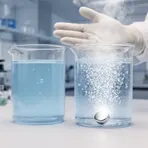
A substance that makes a chemical reaction go faster without being changed
 1
7.0
1
7.0
A substance that makes a chemical reaction faster without being used up
Antonyms

Compounds

How Catalytic


Surface Forms
Etymology
Catalyst comes from Greek parts kata- 'down' and lysis 'loosen', so you can think of it as something that 'loosens' a chemical process. In chemistry a catalyst helps a reaction happen faster by making it easier for the parts to change, and it does this without being changed itself.