
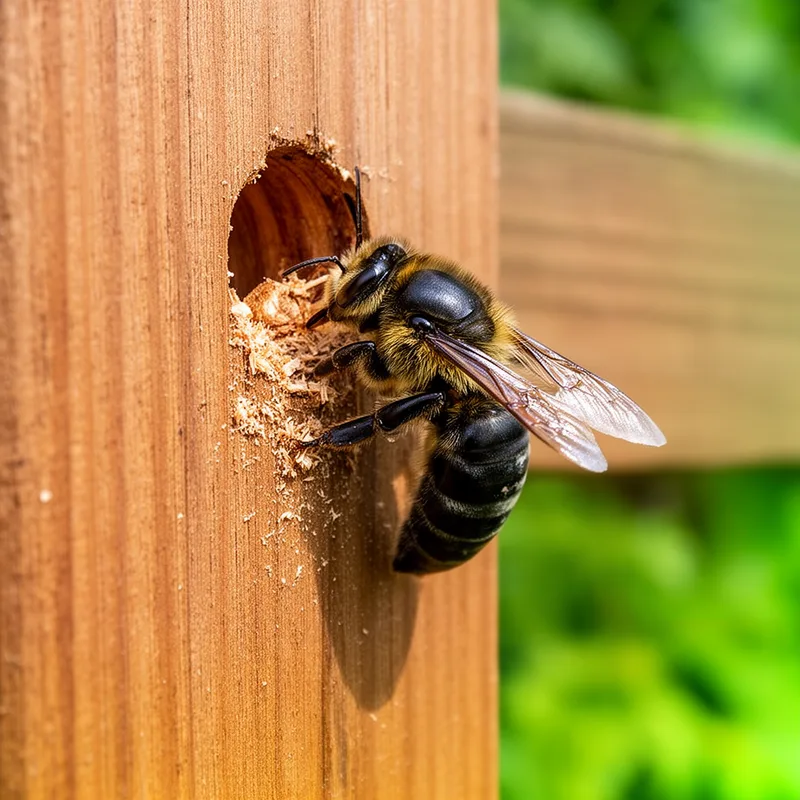
carpenter bee


 1
6.4
1
6.4
- noun
- /ˈkɑːrpəntər biː/
- The carpenter bee burrows into wood to lay its eggs, which can weaken wooden structures.
- a giant carpenter bee
Examples
-
What we called bumblebees were really wood bees, or as some call them, carpenter bees.
Blog text (3) -
You got carpenter bees.
-
- Do carpenter bees make honey?
-
Neere had never heard of carpenter bees.
Fiction book (1990) -
A male carpenter bee, identified by a yellow facial spot, drinks wisteria nectar.
Academic text (1994) -
"One bee we're studying for pollinating tomato plants is an Arizona native called a giant carpenter bee."
Academic text (1994) -
A pink gentian grows in southern Africa, which is pollinated by handsome furry carpenter bees.
Blog text (32) -
Occasionally thereafter, we saw what everybody called bumblebees, but we never again saw them act like carpenter bees, although friends said they were known in New Jersey; black varnished abdomens distinguished them from furry-bellied bumblebees.
Fiction book (1990) -
Like the fuzzyfoot, the giant carpenter bee "flexes its powerful flight muscles so fast they create sonic energy that causes pollen to shoot out of the tomato flower's hollow anthers.
Academic text (1994) -
PHOTO (COLOR): Buzz pollinator: Entomologist Steven Buchmann observes a giant carpenter bee, which uses rapid vibrations to release pollen.
Academic text (1994)
Synonyms

A group of large carpenter bees that bore into wood to make nests

A large bee that lives alone and tunnels into wood to make a nest
How Social

Surface Forms
Morphology
carpenter + bee
The compound combines 'carpenter' (woodworker) and 'bee' (insect), so a learner who knows both words can readily infer it refers to a bee associated with wood—i.e. one that bores into or nests in wood or plant stems. This form of noun compounding is a transparent, compositional pattern common across languages, so the meaning is predictable to a B1 learner.
Etymology
Carpenter bee is named for what it does: like a carpenter, this bee drills holes in wood or plant stems to make a 'nest' for its young. That's why the name helps you remember it is a bee that lays its eggs inside wood.