
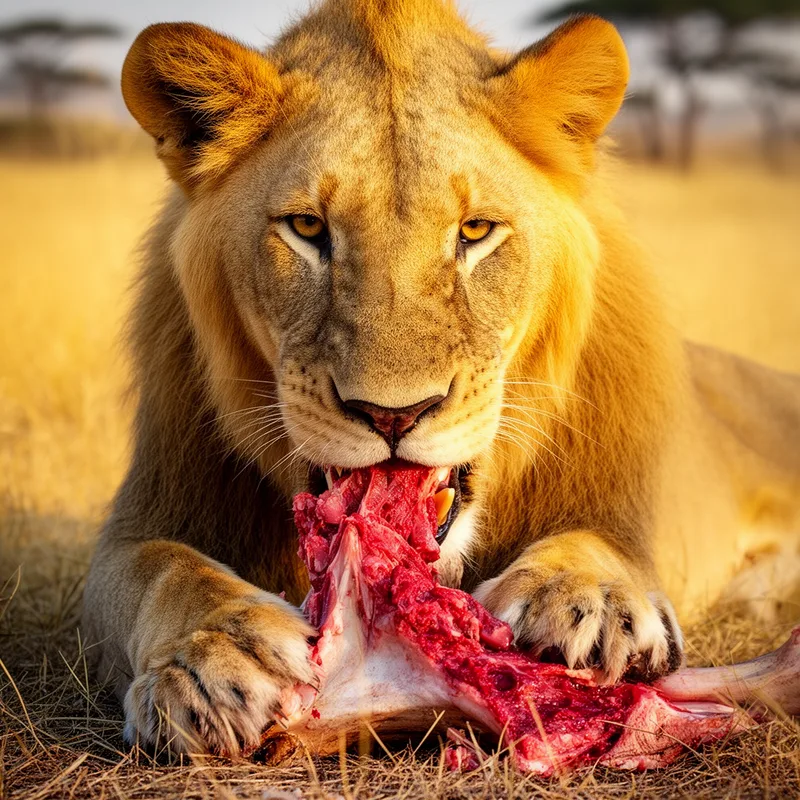
carnivore
 23
3.4
23
3.4

- noun
- /ˈkɑrnɪˌvɔr/
- Despite its fluffy fur and teddy-bear look the polar bear is actually one of the most ruthless, predatory carnivores on the planet.
- mammalian carnivores
- large carnivore
- apex carnivores
Loading YouTube…
Watch on YouTubeYou can include insects because they are also carnivore.
- You can include insects because they are also carnivore.
- People are carnivores and that's the world is brutal.
Examples
-
Most reported cases of rabies occur among carnivores, including raccoons, skunks, and foxes, in addition to many bat species.
Academic text (2012) -
The lion, a well-known carnivore, hunts for food in the savannah every night.
-
There goes the largest carnivore in North America.
-
Not all of us are carnivores.
-
This place seems to be dominated by carnivores.
-
This carnivore has feasted all summer on baby Edmontosaurus.
-
Spotted hyenas are large, gregarious carnivores that live throughout sub-Saharan Africa.
Academic text (1998) -
Tigers are powerful carnivores that primarily hunt deer and wild boar.
-
In the animal kingdom, a carnivore like the great white shark plays a crucial role in maintaining the balance of marine life.
Synonyms
 204
2.9
204
2.9
An animal that hunts and eats other animals
 1
5.1
1
5.1
An animal that hunts and kills other animals to eat

A person or animal that eats meat
Antonyms

How Carnivorous
23
3.4

- Specialized
- Specialized
9
3.9
- Specialized
9
3.7
Surface Forms
Morphology
carnivore = carn + vore
The word is built from Latin combining forms meaning 'meat' (carn-) and 'to devour' (-vore); these are not standalone English words, so the pattern may be partially recognizable (especially -vore) but not fully transparent to all learners.
Etymology
Carnivore comes from the Latin parts carnis 'flesh' and vorare 'to eat'. It literally means a 'flesh-eater', which is why it names an animal that eats meat.