

caddisfly
- noun
- /ˈkædɪsˌflaɪ/
- Many caddisflies are found near rivers, where their larvae create intricate homes from debris.
- caddisfly larvae
Loading YouTube…
Watch on YouTubeSo we have a small caddisfly, a large caddisfly, mayfly, stone flies, and fly larvae.
- So we have a small caddisfly, a large caddisfly, mayfly, stone flies, and fly larvae.
Examples
-
So we have a small caddisfly, a large caddisfly, mayfly, stone flies, and fly larvae.
-
Caddisfly larvae make their odd masonry houses with it.
Academic text (1998) -
We created a training set of images of 54 taxonomic groups covering most of the stoneflies, caddisflies, and mayflies found in the US Pacific Northwest.
Academic text (2017) -
A caddisfly larva builds an intricate hideaway from grains of sand or other debris carefully.
Academic text (2003) -
In swift water, caddisfly larvae and other scavengers feed inside gill cavities or beneath carcasses for protection from the current.
Academic text (1997) -
Certain caddisfly larvae are similarly dependent on terrestrial inputs and have been found only on alder roots protruding into the stream (Flory and Milner 1999).
Academic text (2007) -
A caddisfly larva builds a protective case from small stones and plant materials in the water.
-
The presence of caddisflies indicates a healthy aquatic ecosystem in the stream.
Synonyms
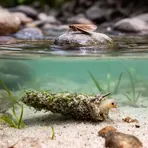
A small insect with wings like a moth whose larvae live in water and build cases from sand and plants

A small moth-like insect whose young live in water and build cases from sand and plants
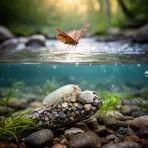
A small insect like a moth whose young live in water and build protective cases from stones and plants

A small moth-like insect whose young live in water and build cases from pebbles and plants

A small insect whose young live in water and build a case from sand and plant bits
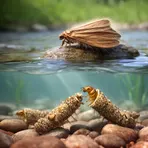
An insect like a caddis fly whose larvae live in water and build protective cases
Surface Forms
Morphology
Etymology
Caddisfly probably comes from an old word caddis meaning 'case' or 'pouch', because the larvae make small protective cases from sand, stones, or plant pieces. So thinking of a caddisfly as an insect that carries a tiny 'case' helps explain its name.

