

cabbage palm
- noun
- US
- Today, because of a rise in the Gulf of Mexico of about a foot, cabbage palms on the upper peninsular coast of Florida are dying.
Examples
-
Many people enjoy the taste of cabbage palm leaf buds, which are popular in regional cuisines.
-
Joining the cabbage palm in the upper tier of the forest are four semideciduous species.
Academic text (1995) -
The most conspicuous of these is a cabbage palm, one of the royal palms.
Academic text (1995) -
Among the trees are American elm, cabbage palm, live oak, pignut hickory, southern magnolia, and sugarberry.
Academic text (2010) -
Newsom has found that the Calusa used a number of wild plants like prickly pear, cabbage palm, saw palmetto, hog plum, and acorns.
Academic text (2004) -
In a traditional dish, the young leaf buds of the cabbage palm are often cooked and served as a vegetable.
-
The chef prepared a salad using the tender leaves of the cabbage palm for an unique flavor.
Synonyms

 46
1.0
46
1.0

A tall tree with one straight trunk and big leaves at the top
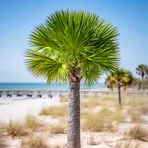
A palm tree with fan-shaped leaves that grows along the southern US coast

A low palm tree with fan-shaped leaves and an edible heart
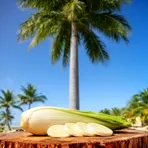
A tall palm tree from the Caribbean with young leaf buds you can eat called cabbage

A palm tree from Brazil that makes açaí berries and has young buds you can eat like cabbage

An Australian palm tree whose young leaf buds are eaten
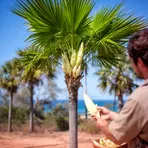
An Australian palm tree with fan shaped leaves and edible young leaf buds
Surface Forms
Morphology
The meaning is directly compositional: it names a type of palm associated with a ‘cabbage’ (the edible young leaf buds), so a learner who knows 'cabbage' and 'palm' can infer it denotes a palm with cabbage-like/edible buds. This follows a common English noun+noun plant-naming pattern (e.g., 'cabbage tree', 'date palm'), making the sense immediately accessible to a B1 learner.
Etymology
Cabbage palm may come from the simple picture of people eating the soft young shoot at the top of the tree: the young leaf bud looked like a small cabbage on a palm. That's why the name now refers to a palm whose young shoots are eaten like a 'cabbage'.