
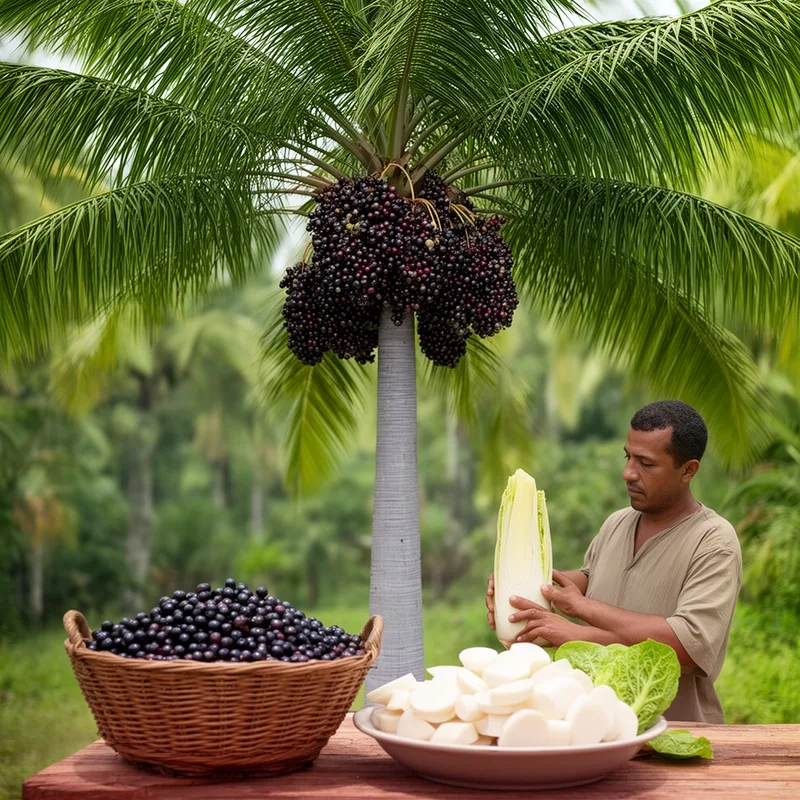
Euterpe oleracea
- noun
- Specialized
- The young leaf buds of Euterpe oleracea are harvested and cooked much like cabbage.
Examples
-
The Euterpe oleracea is often referred to as the açaí palm.
-
Many rainforest communities rely on Euterpe oleracea as a staple crop and economic resource.
-
Farmers in Brazil cultivate Euterpe oleracea both for its edible shoots and its popular açaí berries.
-
Many health benefits are associated with Euterpe oleracea.
-
Farmers in Brazil cultivate Euterpe oleracea to enjoy its edible shoots and the nutritious açaí berries.
-
The young leaf buds of Euterpe oleracea are commonly harvested and prepared as a vegetable dish, similar to cabbage.
-
Many communities in the Amazon rely on Euterpe oleracea for food and as a source of income from its açaí production.
Synonyms


 1
7.7
1
7.7
A tall tropical palm that grows small dark purple berries
Surface Forms
Morphology
Euterpe + oleracea
This is a Latin binomial taxonomic name functioning as a proper name rather than a compositional English phrase, so its full meaning (the açaí palm and its edible buds/berries) is not derivable from the parts. One constituent ('oleracea') is not an English lexical item and even knowing 'Euterpe' as a genus does not let a B1 learner infer the common-name details, making the expression non-compositional for learners.
Etymology
Euterpe oleracea gets its name from two old words: Euterpe, the Greek muse of music, and oleracea, a Latin word meaning 'vegetable' or 'edible plant'. People named it this because the palm gives the tasty 'açaí' berries and young leaf shoots that are eaten like cabbage, so the name points to a plant used for food.