

to burst out
 9
3.3
9
3.3

- phrasal verb
- /bɜrst aʊt/
- And then hearing himself do that, he burst out laughing and signed the kids paper.
- burst out laughing
- burst out crying
- burst out giggling
Loading YouTube…
Watch on YouTubeAnd when you said that on the podcast, I burst out crying.
- And when you said that on the podcast, I burst out crying.
- And when he told me that, I actually burst out into tears because I was so happy for him.
- I mean, it's so mispronounced that you would burst out laughing probably.
- I walked on stage and for some reason I burst out laughing and I did not stop.
- Upon receiving this Barb, Aratus is said to have burst out laughing.
- And he just looked at me and he just burst out laughing like that.
- Just when I look in the mirror, I burst out crying just facing myself.
- And she said, OK, burst out crying.
- That's what I meant, that they're sitting on this crater of volcanic crater of anger, which sometimes bursts out of them.
- I mean, when when my uncle or my auntie walks in the room or my sister walks in and just bursts out crying, it's like, whoa, what can you see that that I can't?
- You know, she just gags and she just burst out laughing.
- Her nurse, Celine goes up, listens to her chest, bursts into tears, runs out of the room, and she just never breathed again.
- Not only does he have to not care about bursting out busting out on the bubble, he has to not care so much that he won't even look at his cards.
Examples
-
And when he told me that, I actually burst out into tears because I was so happy for him.
-
I walked on stage and for some reason I burst out laughing and I did not stop.
-
So my dad burst out into tears and he said I have cancer and I only have six months to live.
-
And he just looked at me and he just burst out laughing like that.
-
The woman had such a serious voice and such huge feet that I burst out laughing.
Fiction book (1993) -
"There was silence again, and suddenly they all burst out in a wave of laughter.
Fiction book (1993) -
And the whole big, great, big auditorium, the whole audience burst out laughing.
-
My bewildered look must have struck him as comic, for he burst out laughing.
Fiction book (1991) -
Robert Lindsay introduced me as Elvis, and the class burst out laughing.
Academic text (2009) -
After hearing the funny joke, we all burst out laughing together.
Synonyms
 187
3.5
187
3.5
To suddenly show a strong feeling, often anger
 152
3.5
152
3.5
To say something loudly so people can hear
 151
4.0
151
4.0
Say something quickly and angrily after losing control
 123
4.2
123
4.2
To suddenly start in a strong or violent way, often showing strong feeling
 108
1.8
108
1.8
Shout loudly to show a strong feeling, for example when surprised or hurt
 81
3.4
81
3.4
Say something suddenly and loudly because you feel surprised or excited
 59
4.8
59
4.8
To say something suddenly without thinking because you feel excited or nervous
 50
4.0
50
4.0
Suddenly start making a sound, like singing, laughing or crying
 50
3.1
50
3.1
Make a sound like a laugh, cry, or sigh
 42
3.9
42
3.9
Say something suddenly without thinking
 42
1.8
42
1.8
Suddenly let out strong feelings or sounds
 13
4.2
13
4.2
Say something loudly to show strong feeling or get attention
 9
3.2
9
3.2
To make a sound or speak after a time of silence
 6
3.9
6
3.9
Make a sudden loud sound, like a shout or laugh
 2
8.7
2
8.7
To say something suddenly and loudly because of surprise or strong feeling
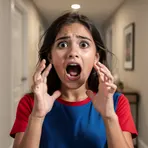 1
2.1
1
2.1
To make a loud sudden cry because you are scared, hurt, or surprised
 1
8.1
1
8.1
To suddenly say something angry without warning
 1
3.2
1
3.2
To suddenly breathe in sharply because you are surprised, shocked, or in pain
 1
9.5
1
9.5
To make a short silly sound suddenly
Antonyms

How Sudden

Surface Forms
Morphology
The meaning 'to suddenly express or release an emotion/utterance' is directly derivable from combining 'burst' (to release suddenly) with 'out' (outward direction); the image of something breaking forth outward matches the MWE sense. This compositional metaphor is common across languages (e.g. 'burst into laughter', 'éclater de rire'), so a B1 learner who knows the constituents will very likely infer the meaning.
Etymology
Burst out comes from the image of something under pressure suddenly breaking and coming out, like a laugh or shout that suddenly comes from the mouth. Burst means a sudden break and out shows movement away, so it means 'to suddenly say something or express an emotion'.