
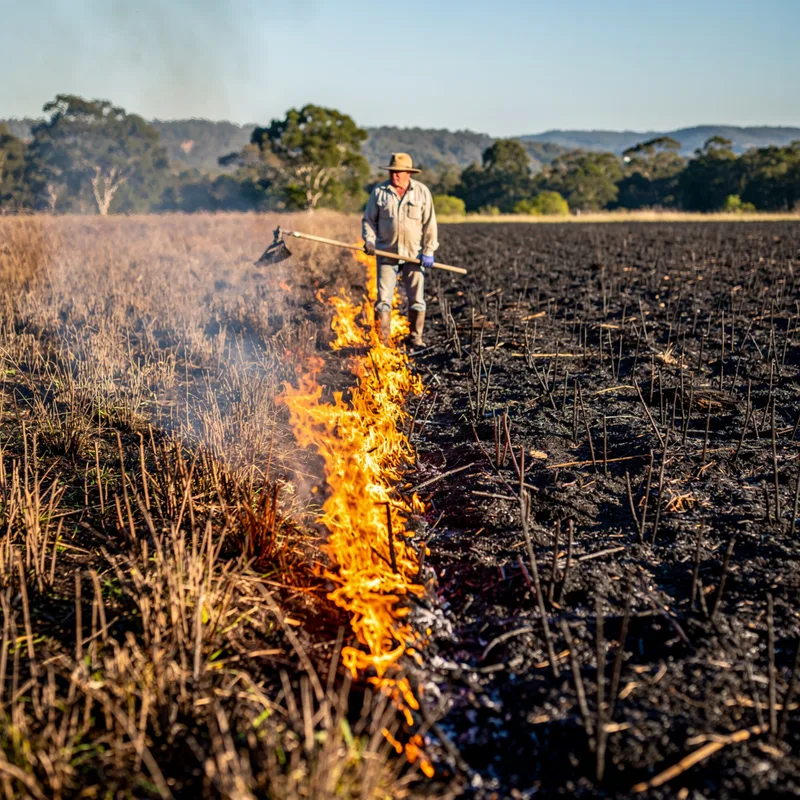
to burn off
 1
5.6
1
5.6

- phrasal verb
- /bɜrn ɔf/
- Ranchers in the area often burn off the dry grass to prepare the land for new crops.
Loading YouTube…
Watch on YouTubeWhile the Germans were busy bustling enormous robot construction systems across space, the Japs were still burning off the jungles in the interior of Brazil.
- While the Germans were busy bustling enormous robot construction systems across space, the Japs were still burning off the jungles in the interior of Brazil.
Examples
-
On the day after my father had tied the dime around my neck, Sister Roberta had to walk past our neighbor's field right after he had cut his cane and burned off the stubble, and a wet wind had streaked her black habit with ashes.
Fiction book (1991) -
The forestry division was burning off overgrowth that time of year, and fingers of dark damp smoke curled up from the weeds to the edge of the asphalt.
Fiction book (1991) -
In North Dakota, the valuable product of the drilling and extraction-related employment is oil; the associated gas produced is actually burned off in a process called "flaring" because there are no paying customers who want it.
Blog text (24) -
It will not happen again for many years to come since all the underbrush will finally be burned off after years of allowing it to accumulate.
Blog text (20) -
To promote new growth in the pasture, farmers burn off the old vegetation every spring.
-
Before planting, they decided to burn off the underbrush to improve soil quality.
Synonyms
 ∞
1.0
∞
1.0
To be on fire or damage something with heat
 31
4.8
31
4.8
To burn something completely so it is destroyed
 27
3.7
27
3.7
To be completely destroyed by fire
 8
7.4
8
7.4
To burn until it turns to ash
 6
3.2
6
3.2
Become used up by fire or slowly disappear over time from heat and light
 1
5.1
1
5.1
To make something start burning

To burn weeds with fire to get rid of them, often said as a joke
Antonyms


How Cleared

Surface Forms
Morphology
The meaning 'to clear vegetation by setting fire' is directly derived from combining 'burn' (to set on fire) with the particle 'off', which commonly signals removal or separation. This verb+particle composition is a regular, compositional English pattern and is cross-linguistically plausible, so a B1 learner who knows the constituent meanings would likely infer the MWE's meaning.
Etymology
Burn off comes from farmers who set fire to old plants to clear fields: burn (set on fire) and off (away). That's why 'burn off' means 'to clear land by fire'.