
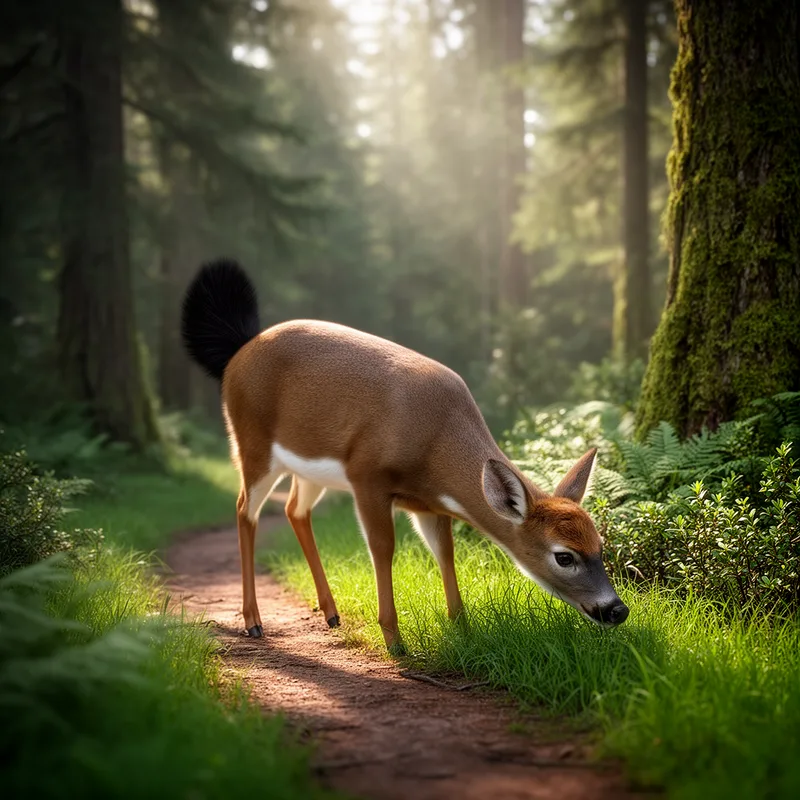
blacktail deer


 1
6.7
1
6.7
- noun
- /ˈblækˌteɪl dɪr/
- US
Examples
-
Each fall, he takes hunters to the north of Kodiak on a search for blacktail deer.
Fiction book (1992) -
During our hike, we spotted a blacktail deer grazing peacefully in the meadow.
-
The guide explained that blacktail deer are well adapted to the dense forests of the Pacific Northwest.
-
Many photographers come to the area to capture images of the beautiful blacktail deer in their natural habitat.
Synonyms
 330
1.0
330
1.0
A wild animal with hooves and antlers that lives in forests and fields
 4
5.6
4
5.6
A large deer with long ears and antlers that split into two in western North America
 1
8.7
1
8.7
A type of deer with a black-tipped tail found in western mountains
 1
7.0
1
7.0
A deer in western North America with a black-tipped tail

A deer with a black tail that lives in forests of the western mountains

A large deer that lives in western North America and has very big ears and forked antlers

A deer from North America with long ears and forked antlers
Surface Forms
Morphology
The phrase denotes a type of deer characterized by a black tail and is directly compositional from the constituent elements (black + tail + deer, here represented as 'blacktail' + 'deer'), so a learner who knows the parts can infer it refers to a deer with a black tail. This descriptive compound follows common noun-compounding patterns cross-linguistically, making its meaning immediately derivable.
Etymology
Blacktail deer gets its name from the animal's dark tail: the parts black and tail describe the deer's dark rear, and early hunters used that mark to tell it apart from other deer. So the name simply points to the dark tail and helps people identify the animal.