
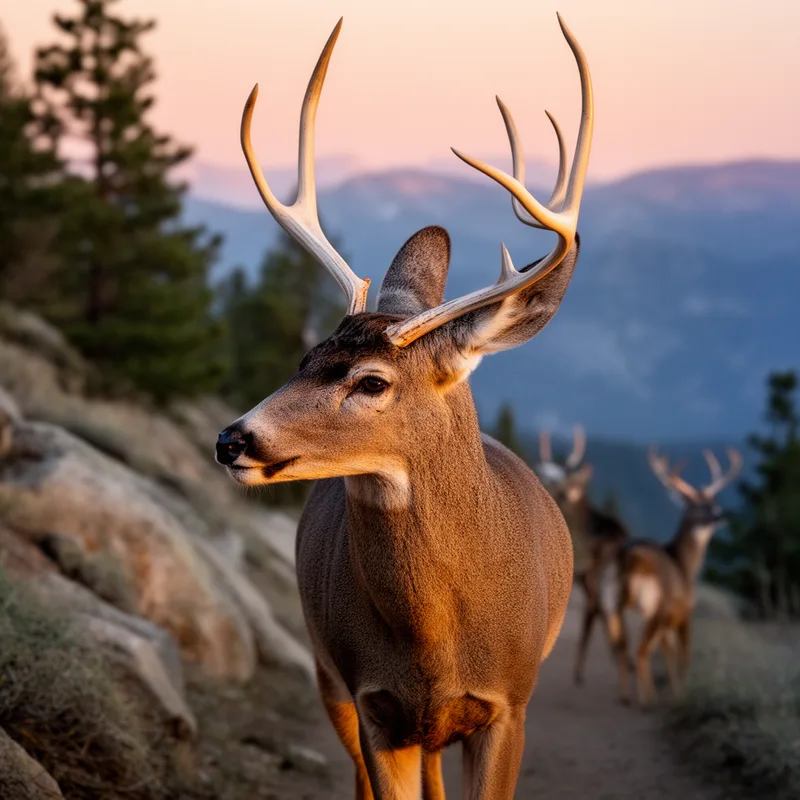
mule deer
 4
5.6
4
5.6

- noun
- /mjuːl dɪr/
- Specialized
- In the early morning light, we spotted a mule deer standing majestically on the hillside.
- mule deer and bighorn sheep
- mule deer and sheep
Examples
-
The Miwok hunted mule deer, fished for salmon, ground up acorns, and made woven baskets.
Blog text (2) -
Antelope Island is home to mule deer, bighorn sheep, antelope, and a bison herd of 600 animals.
Academic text (2005) -
That's a mule deer, Griffin.
-
Near the Royal Gorge, we will stop to take pictures of the mule deer roaming free.
Academic text (1994) -
A mule deer leaped from the dense brush and dipped across the changing river.
Fiction book (1994) -
Looking Loon rode into camp one evening with a mule deer draped over his horse's withers.
Fiction book (1994) -
Boaters three miles offshore saw an exhausted mule deer doe swimming out to sea, away from the blighted canyons where she usually foraged.
Fiction book (1994) -
Between the hills once lay little valleys of oak and meadow, where mule deer grazed and condors soared.
Fiction book (1990) -
While hiking in the mountains, we were fortunate to see a mule deer grazing peacefully in the clearing.
-
During the wildlife tour, the guide pointed out several mule deer that were resting under the trees.
Synonyms


 1
7.0
1
7.0
A deer in western North America with a black-tipped tail

A deer from North America with long ears and forked antlers

A large deer that lives in western North America and has very big ears and forked antlers
Surface Forms
Morphology
The compound follows a transparent noun+noun composition where the modifier 'mule' indicates a deer with mule-like characteristics (notably long ears), so learners who know both words will likely infer it names a kind of deer. However, because 'mule' primarily denotes a donkey–horse hybrid, the exact nature (species name vs. hybrid) and the specific traits are not fully predictable without exposure, making the relation only partially clear to B1 learners.
Etymology
Mule deer: The name mule deer comes from the animal's very large ears that look like a mule's ears, so people joined mule and deer to describe it. That's why the name refers to the western deer known for big ears and forked antlers.