
black rhinoceros


 1
6.7
1
6.7
- noun
- /blæk raɪˈnɒsərəs/
- South African
- The black rhinoceros is critically endangered due to habitat loss and poaching.
Examples
-
Efforts are being made to protect the black rhinoceros from extinction in Africa.
-
We see that the figure is a large, black rhinoceros!
Fiction book (1990) -
The black rhinoceros often hosts the larva of the fly Gyrostigma rhinocerontis.
Academic text (2006) -
Populations of the black rhinoceros fell by a staggering 96 percent between 1970 and 1992; the species is still endangered, but the population has risen to 3,500.
Academic text (2006) -
In 1847, the French naturalist and explorer Adulphe Delegorgue described large numbers of bots in the stomach of a black rhinoceros from northeastern South Africa.
Academic text (2006) -
One of them, G. conjungens, was discovered in its bot form in the belly of a Kenyan black rhinoceros in 1901, but it hasn't been collected, or even seen again, since 1961.
Academic text (2006) -
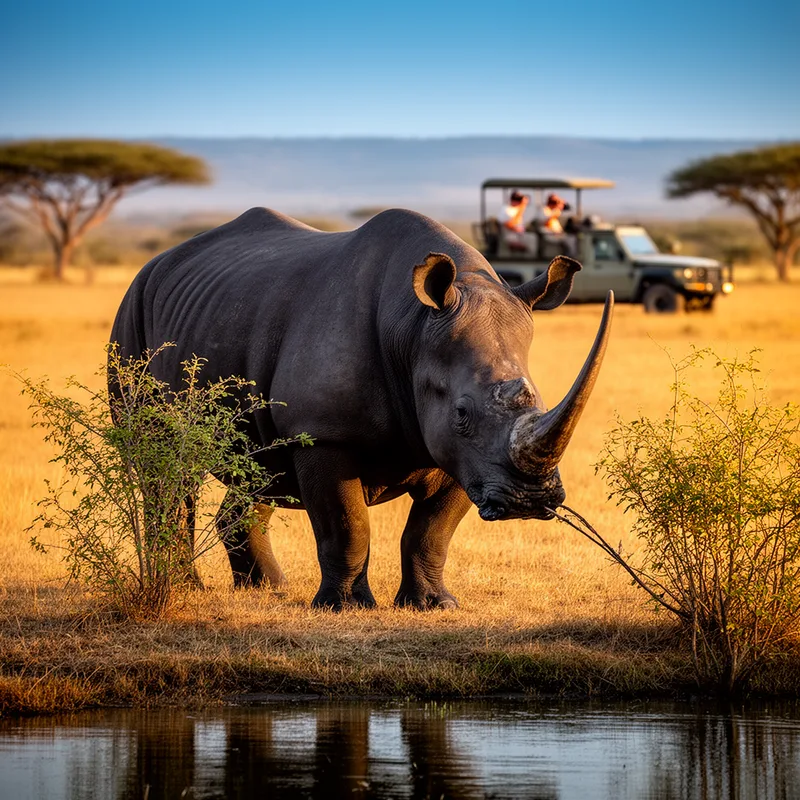
In a wildlife sanctuary, the black rhinoceros grazes peacefully on leafy shrubs.
Synonyms

A large African rhino with two horns that is endangered
How Endangered

Surface Forms
Morphology
The phrase 'black rhinoceros' is transparently compositional: the adjective 'black' modifies 'rhinoceros', so a learner who knows both words will infer it denotes a kind/type of rhinoceros (presumably dark-colored or named so). This simple adjective+noun structure is common across languages and follows regular English composition, making the meaning accessible to a B1 learner.
Etymology
Black rhinoceros One popular story says the name comes from a language mix-up: early Dutch speakers used a word meaning 'wide' to describe the rhino with a wide mouth, and English speakers heard it as 'white', so the other kind with a pointed lip was called black to tell them apart. So black rhinoceros is the species name, not a description of its color.