
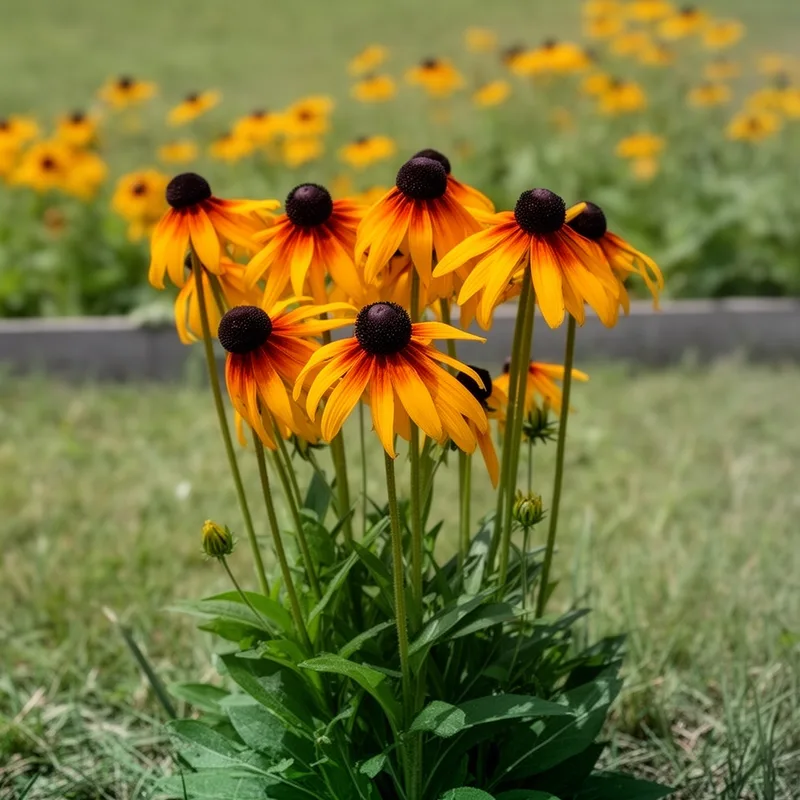
black-eyed Susan


 1
5.1
1
5.1
- noun
- /ˈblækˌaɪd ˈsuːzən/
- US
- She kicked again, and the horse's legs began churning through the oat grass until the black-eyed Susans blurred into streaks of yellow.
- wildflowers and black-eyed Susans
- black-eyed Susans and daisies
Examples
-
"He walked to her and held out a small bouquet of wildflowers, black-eyed Susans.
Fiction book (1992) -
Black-eyed Susan in the meadows, Indian paintbrush by the road, lady's slippers in the shady spots.
Fiction book (1995) -
In my garden, the bright yellow petals of the black-eyed Susan attract many butterflies.
-
During summer, the fields are filled with black-eyed Susans swaying gently in the breeze.
-
The florist arranged a beautiful bouquet featuring black-eyed Susans alongside other wildflowers.
Synonyms
A North American flowering plant with yellow or orange petals and a dark centre
A daisy-like wildflower with yellow or orange petals and a dark center, and the state flower of Maryland
Surface Forms
Morphology
black-eyed + Susan
The modifier 'black-eyed' transparently indicates an object with a dark (black) eye/center, so a learner who knows 'black' and 'eye' can infer the visual property. However, 'Susan' is an arbitrary personal name used in the conventional name of a flower and does not itself signal 'plant' or 'flower', so the exact lexicalization (that this is the name of a specific plant) is not fully predictable without exposure.
Etymology
Black-eyed Susan likely comes from the flower's appearance: bright yellow or orange petals around a dark brown or black center make the flower look black-eyed, and the familiar name Susan was added to give the plant a simple name people could remember. That's why the name describes this cheerful wildflower with a dark center.