
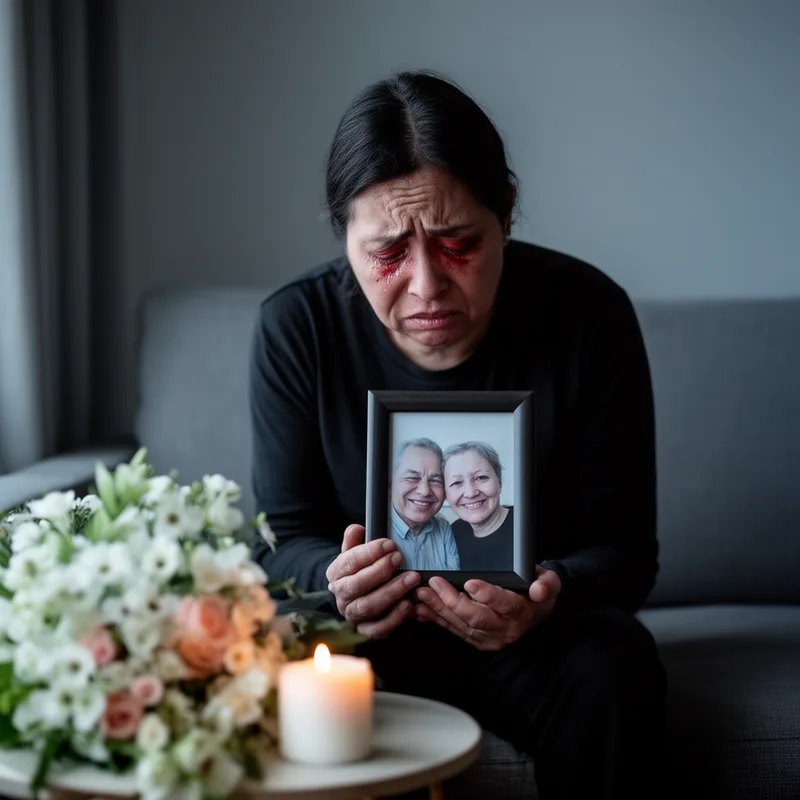
bereaved person
- noun
- /bɪˈrivd ˈpɜrsən/
- Formal
- After losing her grandmother, the bereaved person struggled to cope with her emotions.
- bereaved people can benefit
- bereaved people experience
Loading YouTube…
Watch on YouTubeAnd yeah, it was, it was the first time I come face to face with recently bereaved people and where that bereavement was a child.
- And yeah, it was, it was the first time I come face to face with recently bereaved people and where that bereavement was a child.
Examples
-
Tudiver, Hilditch, Permaul, and McKendree (1992) revealed that bereaved people experience severe mental and physical health problems for a one-year period after the death of a spouse.
Academic text (2011) -
Employers, family members, friends, and bereaved people themselves have expectations for a quick recovery.
Academic text (2011) -
The bereaved person knows he or she must move on to live life more fully.
Academic text (2011) -
If family and friends understand this model, they may be more accepting of identity changes the bereaved person makes.
Academic text (2011) -
Bereaved people can benefit from this model if others in their lives have a better understanding of the process.
Academic text (2011) -
In addition, bereaved people can benefit from counselors having an understanding of the model.
Academic text (2011) -
During the preparation stage, the bereaved person recognizes that moving forward must occur and that the time for permanent changes is approaching.
Academic text (2011) -
Family and friends may be more likely to offer support through the maintenance process, rather than assuming that once the bereaved person appears to have a new state of functioning, the grieving process has ended.
Academic text (2011) -
Caution must be taken in assuming that a bereaved person's status at a particular time is reflective of his or her overall progress and movement toward change.
Academic text (2011) -
For example, family and friends may be less likely to expect the bereaved person to "just get over it," particularly if the family and friends do not recognize the difference between a normative and non-normative loss.
Academic text (2011)
Synonyms
 39
4.0
39
4.0

A person who feels sad because someone has died
 2
7.8
2
7.8
A person who has lost someone they loved to death


 1
7.2
1
7.2
A person who feels deep sadness after someone close dies
A person who feels deep sadness after losing someone
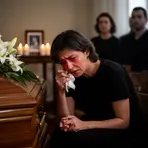
A person who shows sadness at a funeral or after a death
How Sad

Surface Forms
Morphology
The meaning 'someone who has suffered the death of a loved one' is directly and compositionally derived from 'bereaved' (grieving a loss) + 'person' (a human individual). This adjective+noun structure is transparent and cross-linguistically common, so a B1 learner who knows both constituents would understand the MWE.
Etymology
Bereaved person comes from an old word that meant 'to rob' or 'take away'. Imagine someone who has been robbed of a loved one and now feels empty, and that image explains why bereaved person means 'someone who has lost a loved one'.