
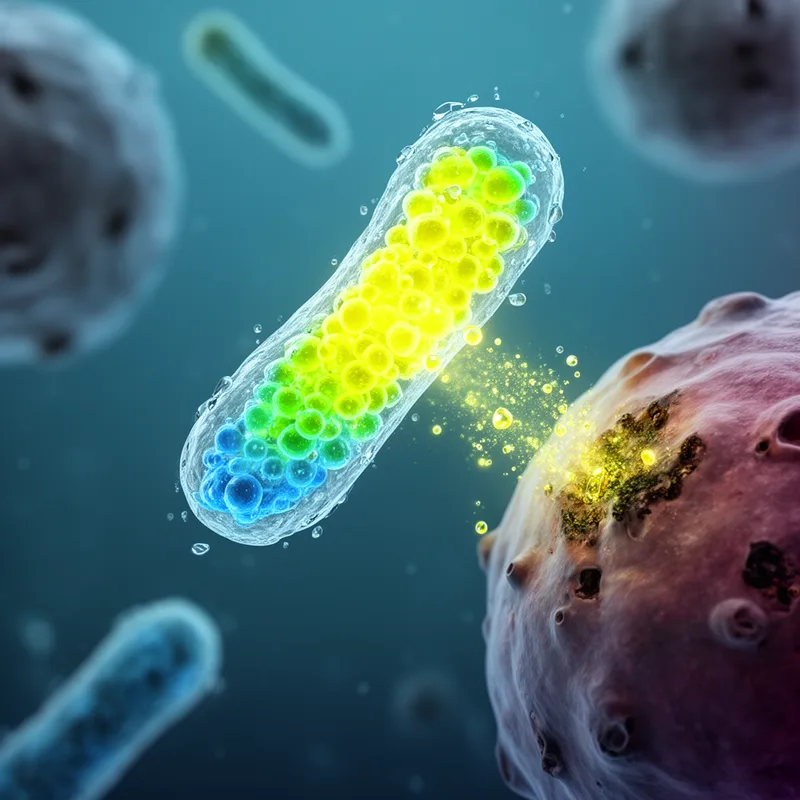
bacterial toxin


 1
3.9
1
3.9
- noun
- /bækˈtɪr.i.əl ˈtɒk.sɪn/
- Specialized
- Scientists are exploring the effects of bacterial toxins on human health.
Examples
-
Human-specific bacterial toxins make pores in erythrocyte membranes.
Academic text (2017) -
Crops are augmented with bacterial toxins that repel plant-eating insects.
Blog text (4) -
Electric charge interaction causes the release of bacterial toxins.
Academic text (2017) -
Her semi-automated method has several advantages over other methods and may detect multiple bacterial toxins in a single food sample.
Academic text (2005) -
Another device for removing bacterial toxins from blood, useful for treating sepsis, was patented 10 years ago.
Academic text (2017) -
The inactivation of bacterial toxins may prevent oxygen release and the penetration of bacteria into erythrocytes.
Academic text (2017) -
When a bacterial toxin enters your system, it stimulates your body's white blood cells to make cytokines, which are hormones that start the inflammation process.
Blog text (6) -
Bacterial toxins injure erythrocyte membranes and form pores that allow bacterial penetration.
Academic text (2017) -
If not properly handled, bacterial toxins in food can make people very sick.
-
The medical team discussed how the patient's symptoms were linked to bacterial toxins in the bloodstream.
Synonyms
 367
2.1
367
2.1
A substance that makes people, animals, or plants very ill and can cause death
 140
5.3
140
5.3
A poisonous substance that some animals, plants, or bacteria make
 3
7.9
3
7.9
A poisonous substance made by a living thing like a plant, animal, or germ
 1
8.8
1
8.8
A poison some bacteria release when they die
 1
9.9
1
9.9
A very strong poison made by bacteria that causes deadly food poisoning
 1
4.4
1
4.4
Something that can cause serious harm or death when swallowed, touched and breathed
 1
7.5
1
7.5
A very strong poison made by bacteria that stops muscles from working and that doctors use to relax them
A poison some bacteria make and send out from their cells

A poison from some bacteria that damages the lining of the intestines and causes diarrhea

A strong poison made by bacteria that causes severe stomach cramps and diarrhea after people eat contaminated food
A bacterial poison that causes severe stomach pain and diarrhea after eating contaminated food

A poison made by a kind of bacteria that can make people very sick

A dangerous poison made by bacteria that stops muscles from working and can kill, used in tiny medical doses
A very strong poison made by bacteria that causes a serious illness of the nerves
Antonyms

Surface Forms
Morphology
The meaning 'a poisonous substance produced by bacteria' is directly and compositionally derived from 'bacterial' (relating to bacteria) modifying 'toxin' (a toxic substance). This modifier+noun combination follows a standard, cross-linguistic pattern and would be transparent to a B1 learner who knows both constituent words.
Etymology
Bacterial toxin shows a simple picture: bacterial means it comes from bacteria and toxin means their poison. Imagine tiny bacteria releasing a powerful 'poison' that can hurt your body and 'make you sick', so the phrase means a poisonous substance made by bacteria.