
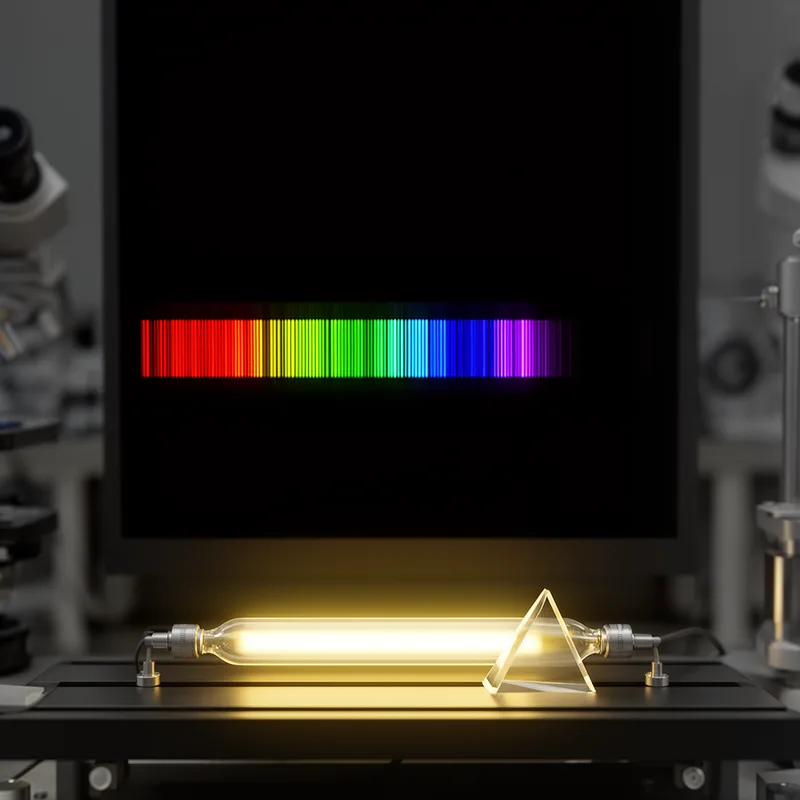
atomic spectrum


 1
6.0
1
6.0
- noun
- /əˈtɑːmɪk ˈspɛktrəm/
- Specialized
- Finally, only a few lines remain unidentified, but those tantalizing few show that work still remains for investigators who study atomic spectra in the laboratory.
Examples
-
From observations of its lines in atomic spectra of red-giant stars, one finds that Tc is being made in such stars by nuclear reactions between other elements.
Academic text (2006) -
Although she retired formally in 1968, she continued to carry out and publish the results of research on atomic spectra until her death on March 1, 1990.
Academic text (1990) -
The spectrum on the right shows extremely sharp discrete excitation resonances reminiscent of an atomic spectrum.
Academic text (2002) -
Wigner's great contribution in the late 1920s and 1930s was to discover the fundamental role symmetry plays in quantum theories, from explaining atomic spectra to classifying types of elementary particles.
Academic text (1995) -
In studying atomic spectra, Wigner needed to analyze the representations of the rotation group, SO(3), plus the discrete symmetries of parity and time reversal.
Academic text (1995) -
The bright lines in the atomic spectrum help scientists identify the elements present in distant stars.
-
Each element has a unique atomic spectrum that serves as a fingerprint for its identification.
-
By studying the atomic spectrum, researchers can learn about the energy levels of electrons in an atom.
Synonyms

Light that shows bright or dark lines at certain colours
Surface Forms
Morphology
The compound meaning is directly derived from 'atomic' (pertaining to atoms) + 'spectrum' (a band of wavelengths), so a learner who knows both words can infer it denotes a spectrum associated with atoms. Detailed physical mechanisms (electron transitions) are technical, but the basic compositional sense is transparent and cross-linguistically predictable.
Etymology
The term atomic spectrum comes from the pattern made when a single atom gives off or takes in 'light' as its electrons jump between energy levels. The thin bright or dark 'lines' in that pattern form the spectrum, and that unique pattern helps scientists identify each element.