
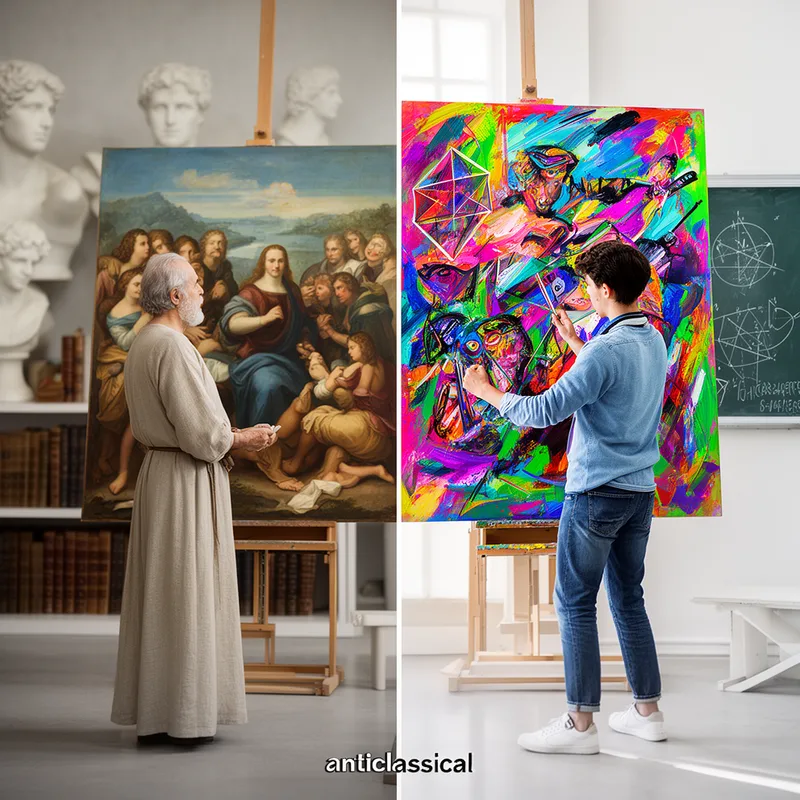
anticlassical
- adjective
- /ˌæn.tiˈklæs.ɪ.kəl/
- Formal
- His anticlassical philosophy rejected the idea that art must conform to classical ideals of beauty and order.
Examples
-
The exhibition featured an anticlassical approach, showcasing works that challenged traditional artistic norms.
-
Their appearance in Picasso's already "grotesque" painting echoed inherited images and evoked associations of superstition, irrationality, darkness, and horror, adding to the artist's considerable arsenal of anticlassical devices.
Academic text (1990) -
That their pro-transitional, pro-French Renaissance, and anticlassical arguments could easily be adapted to St-Eustache was realized by many of their contemporaries.
Academic text (1998) -
For Sage, Lope's expansion of the humor beyond the figura del donaire generates a hybrid (anticlassical) text, a dark comedy that begs to be taken seriously.
Academic text (2000) -
Many artists today embrace an anticlassical style that embraces spontaneity and unconventional techniques.
Synonyms



 1
7.7
1
7.7
Not following traditional ideas or rules in art and science

Not following the old rules of art and science, for example in music

Not supporting traditional ideas and old ways of doing things
Antonyms

How Traditional
994
1.5
 48
3.9
∞
1.4
165
5.5
462
6.0
48
3.9
∞
1.4
165
5.5
462
6.0
- Formal
Surface Forms
Morphology
Etymology
Anticlassical combines anti- meaning 'against', as in antibiotic, and classical, like classic, meaning 'old' or 'traditional'. So an anticlassical approach is one that rejects or goes against classical styles, ideas, or rules.