

afferent fiber
- noun
- /ˈæfərənt ˈfaɪbər/
- Specialized
- Small-diameter afferent fibers connect to interneurons and synaptic mechanisms, which in turn produce long-lasting hyperexcitability.
Examples
-
You stretch the spindle too, OK, What'll happen is that the spindle afferent fibers will start firing.
-
We call them visceral afferent fibers, mostly through the vagus nerve.
-
This pattern of afferent innervation differs dramatically from that seen on inner hair cells, where each inner hair cell synapses with approximately 20 unbranched afferent fibers.
Academic text (1998) -
Secondary vestibular afferent fibers are responsible for making connections with the contralateral vestibular nuclei, oculomotor control areas, the cerebellum, and the spinal cord.
Academic text (2005) -
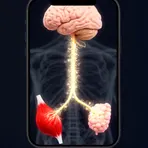
The sensory system relies on afferent fibers to transmit information from the body's periphery to the central nervous system.
-
In response to stimuli, the afferent fibers carry impulses towards the brain, allowing for proper sensory processing.
-
When you touch something hot, the pain signals travel along afferent fibers to alert your central nervous system.
Synonyms

A thin nerve that sends messages about touch, pain, or temperature to the brain
Antonyms
- Specialized
A nerve that carries signals from the brain or spinal cord to muscles and glands
Surface Forms
Morphology
The meaning is directly compositional: 'afferent' (conducting toward the central nervous system) combined with 'fiber' (a nerve thread) yields a nerve fiber that carries impulses inward. Although somewhat technical, the sense follows straightforward morphological composition and would be predictable to learners who already know both constituent words.
Etymology
The term afferent fiber uses afferent meaning 'to carry toward' and fiber meaning a thin thread, so picture a small wire carrying messages toward the brain and spine. That's why it means 'a nerve that brings messages about touch or pain to the brain or spinal cord'.

