
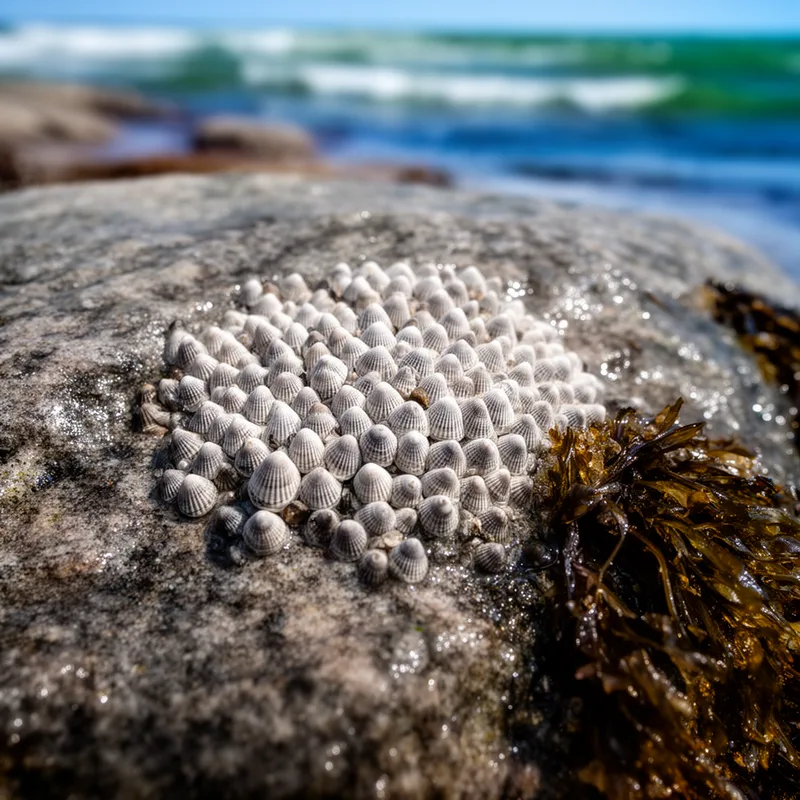
acorn barnacle
- noun
- /ˈeɪkɔrn ˈbɑrnəkl/
- The acorn barnacle clings tightly to the rocks.
Examples
-
At low tide, the rocks were covered with acorn barnacles and seaweed.
-
Children collected shells and observed the acorn barnacles clinging tightly to stones.
-
The acorn barnacle is commonly found along rocky coasts worldwide.
-
Many acorn barnacles can be found along the coast.
-
The rocky shore is covered with acorn barnacles clinging tightly to the surface.
-
During low tide, you can see many acorn barnacles on the exposed rocks at the beach.
-
As we walked along the coast, we noticed several acorn barnacles attached to the driftwood.
Synonyms
 11
6.9
11
6.9

A small sea animal that sticks to rocks and the bottoms of boats and forms a hard shell
A small sea animal with a hard shell that sticks to rocks between tides
A small barnacle that sticks to rocks at low tide on northern coasts
Surface Forms
Morphology
The compound 'acorn barnacle' is transparently compositional: a B1 learner who knows 'acorn' (a small nut with a distinctive shape) and 'barnacle' (a sessile crustacean) can infer it is a barnacle shaped like an acorn. This straightforward noun+noun naming pattern is common across languages and thus easily predictable from the constituents.
Etymology
The name acorn barnacle comes from how this little sea animal looks: its hard shell is shaped like an acorn. Like other barnacles, it 'sticks' tightly to rocks, so the name tells us it is a small, cone-shaped barnacle that clings to the shore.