
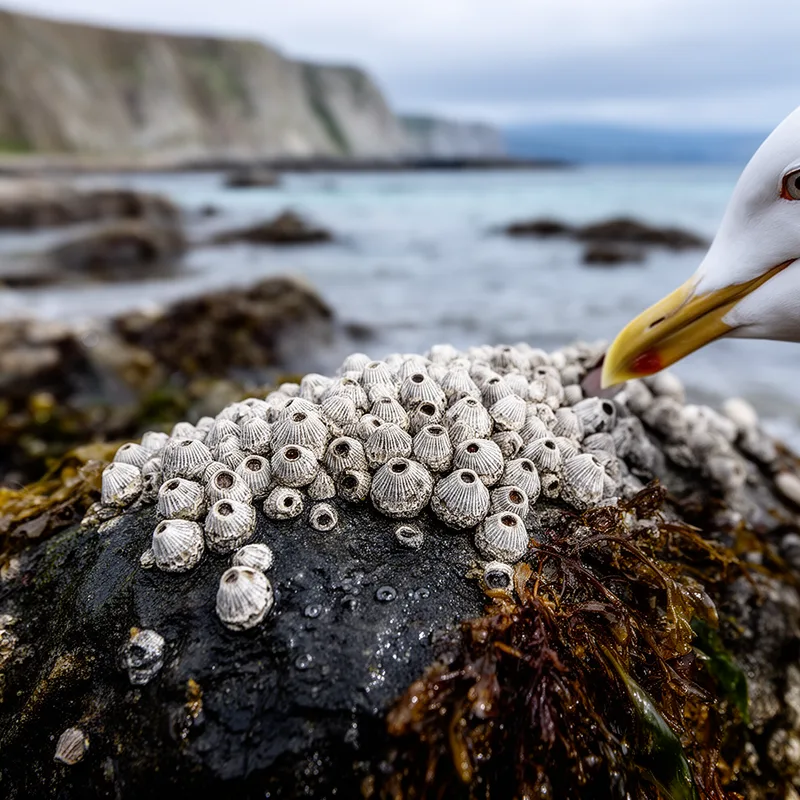
Balanus balanoides
- noun
- Specialized
- During low tide, the Balanus balanoides are clearly visible on the exposed rocks in the intertidal zone.
Examples
-
Researchers studied how Balanus balanoides survived harsh conditions in the intertidal zone.
-
The Balanus balanoides is often found in tidal pools.
-
During low tide, the Balanus balanoides become clearly visible on the exposed rocks.
-
Seagulls often feed on Balanus balanoides found along the rocky shores.
-
Many marine biologists study the Balanus balanoides for its ecological role.
-
Researchers studied how Balanus balanoides adapt to the changing conditions of their rocky habitat.
-
Seagulls often feed on Balanus balanoides that cling to the rocks along the coast.
Synonyms
A small sea animal with a hard shell that sticks to rocks between tides
A small cone-shaped shell animal that sticks to rocks between high and low tide
Surface Forms
Morphology
Balanus + balanoides
This is a Latin binomial (scientific) name: the second element 'balanoides' has no common-English gloss here and is not a transparent, productive English morpheme. Even if a learner knows 'Balanus' as a genus of barnacles, taxonomic epithets are convention-based and not compositionally meaningful to B1 learners, so the overall meaning ('a species of barnacle') cannot be derived from the parts.
Etymology
Balanus balanoides comes from old Greek words: balanus meaning 'acorn' and -oides meaning 'like'. These barnacles look like tiny 'acorns' stuck to rocks, so the name describes the animal.

