
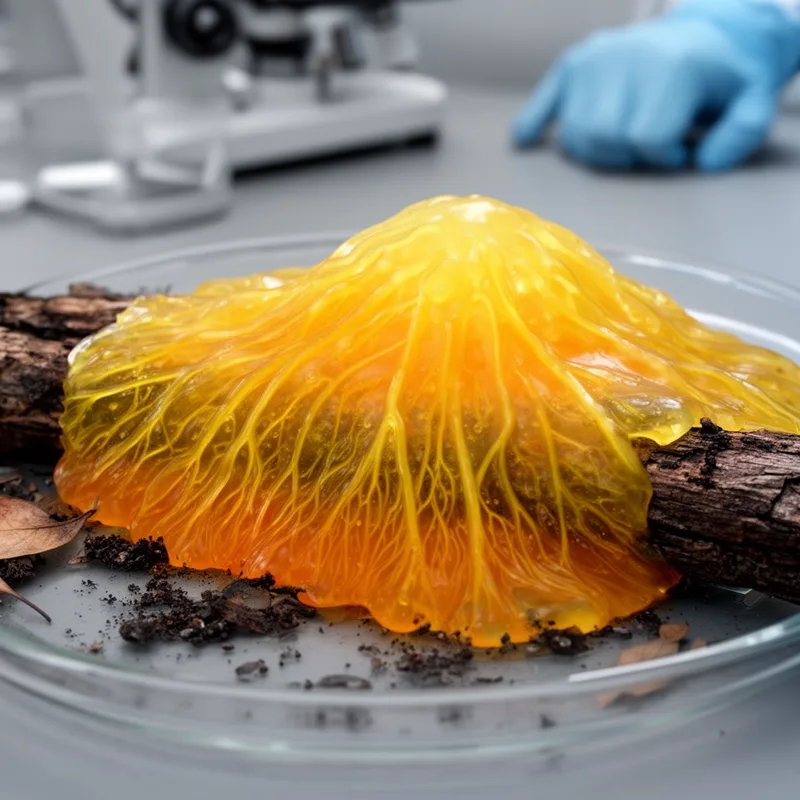
acellular slime mold
- noun
- /ˌeɪˈsɛljələr slaɪm moʊld/
- Specialized
- The acellular slime mold moves as a giant multinucleate mass, searching for food on decaying logs.
Examples
-
Scientists often compare acellular slime molds with cellular slime molds to study their unique life cycles.
-
In the biology lab, we observed an acellular slime mold forming intricate vein-like networks.
-
The acellular slime mold is fascinating to study.
-
Did you see the acellular slime molds in the lab?
-
In the biology lab, we observed an acellular slime mold forming intricate vein-like networks.
-
The acellular slime mold moves as a giant multinucleate mass, searching for food on decaying logs.
-
Scientists often compare acellular slime molds with cellular slime molds to study their unique life cycles.
Synonyms

 2
7.1
2
7.1

A simple living thing that forms a soft moving blob to find food


 1
9.9
1
9.9
A group of slime molds that live as a single soft mass and make spores

A soft slimy living thing like a fungus that grows in damp places

A soft organism that becomes one large cell with many nuclei and moves slowly
Surface Forms
Morphology
The phrase is compositionally transparent: 'acellular' means 'not divided into cells' and 'slime mold' denotes a type of organism, so the phrase straightforwardly means a slime mold that lacks cellular division. This is a regular adjective + noun combination following standard morphological rules, so a B1 learner who knows the constituent words should be able to infer the meaning.
Etymology
Acellular slime mold comes from its parts: acellular means 'not made of separate cells' and slime mold gives the image of a soft, moving blob. This creature is one large, moving mass rather than many separate cells, so the name helps you remember it behaves like a single blob-like organism.