
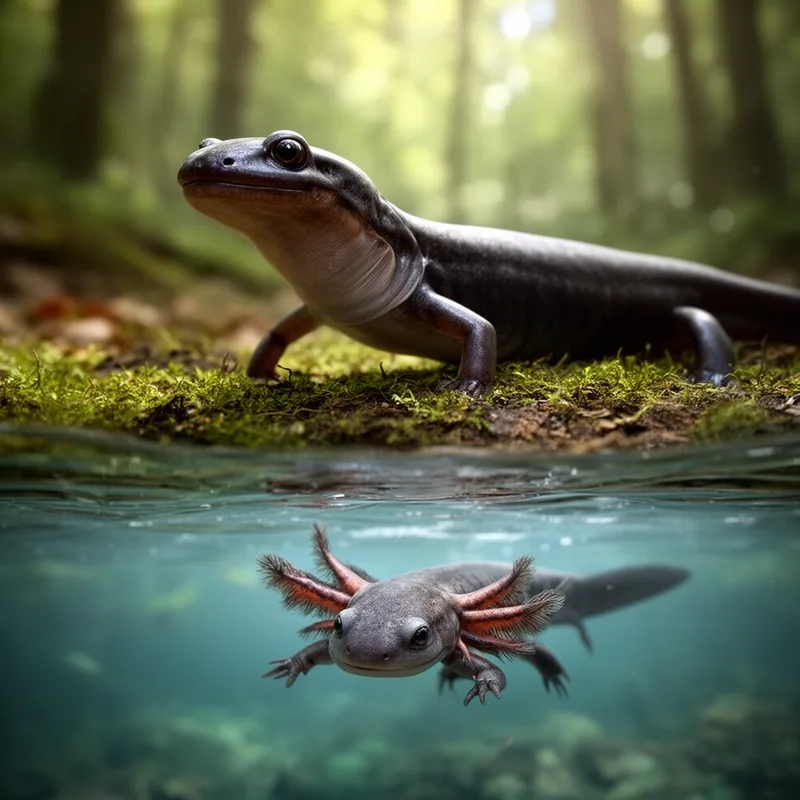
abranchious
- adjective
- /əˈbræŋkiəs/
- Specialized
- The adult terrestrial salamander is abranchious and relies on lungs for respiration.
Examples
-
Unlike its aquatic relatives, this species develops into an abranchious adult.
-
Many abranchious animals rely on lungs for respiration.
-
Some parasitic flatworms are abranchious throughout their entire life cycle.
-
The abranchious species adapted to life on land.
-
The adult terrestrial salamander is abranchious and relies on lungs for respiration.
-
Some parasitic flatworms are abranchious throughout their entire life cycle.
-
Many abranchious animals rely on lungs for respiration.
Synonyms
An animal that has no gills

An animal that has no gills and breathes air
Not having the thin breathing parts on the sides of fish
Antonyms

- Specialized
Having thin plates underneath, as in fish for breathing or mushrooms for making spores
Surface Forms
Morphology
abranchious = branchial (opaque) = a + branchi + ous
The suffix '-ous' forms an adjective from 'branchial', but the prefix 'a-' meaning 'without' is not immediately clear without specialized knowledge.
Etymology
The word abranchious comes from the parts a- 'without' and branchia 'gills'. So an abranchious animal is one that has no gills.

