
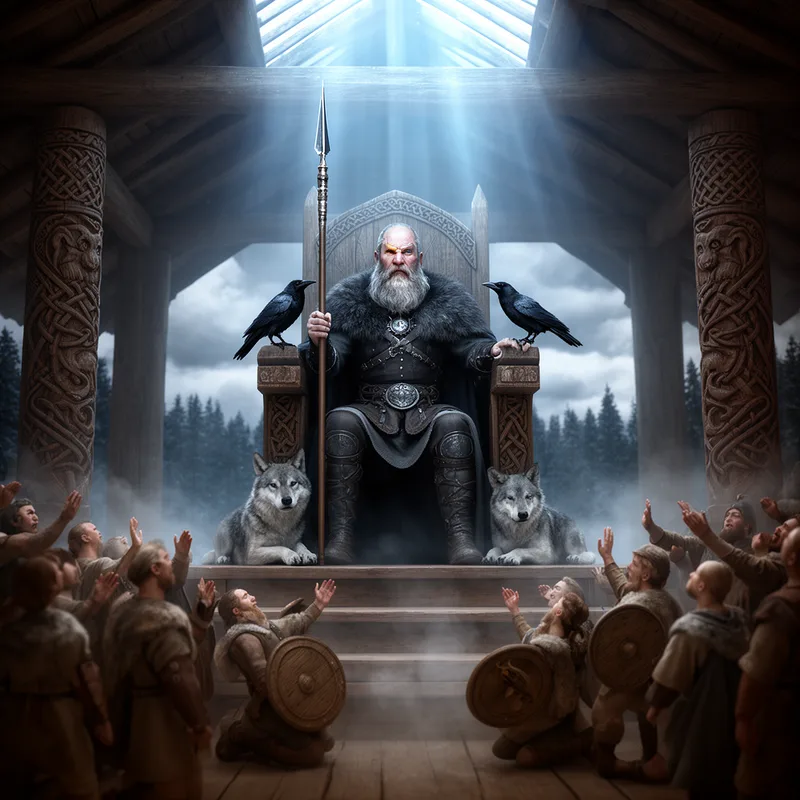
Wodan
- proper noun
- Literature
- Many stories in Germanic folklore feature Wodan leading the Wild Hunt through the night sky.
Examples
-
- Wodan, Thunar, Frua, Wodan, Thunar, Frua, Wodan, Thunar, Frua, Wodan, Thunar, Frua.
-
- Wodan, Ruler of the Sky.
-
- Wodan, Thunar, Frua, Wodan, Thunar, Frua, Wodan, Thunar, Frua, Wodan, Thunar, Frua.
-
- Wodan, Thunar, Frua, Wodan, Thunar, Frua, Wodan, Thunar, Frua, Wodan, Thunar, Frua.
-
- Wodan, Thunar, Frua, Wodan, Thunar, Frua, Wodan, Thunar, Frua, Wodan, Thunar, Frua.
-
Wotan (or Wodan, Woden) was his name among the Southern tribes, including the Saxons, who brought his name into the English tongue to designate the Mercury day as Wodensdag (Wednesday).
Academic text (1990) -
In ancient Germanic mythology, Wodan is revered as the chief god who governs the skies.
-
The name Wodan varies among cultures, as the Saxons referred to him as Wuotan.
Synonyms

 84
8.4
84
8.4

The chief god in Norse myths who is linked with war, poetry, and wisdom
 4
9.9
4
9.9
The chief god in Germanic myths like the Norse god Odin


 1
9.9
1
9.9
The main god in early English stories, like the Norse god Odin
Surface Forms
Etymology
The name Wodan comes from an old Germanic word meaning 'inspired fury' or 'wild spirit', and it is the same figure known as Odin or Woden in other northern stories. That's why he was seen as the chief god who could give fierce strength and sudden inspiration, and you can still see his name today in the English weekday Wednesday ('Woden's day').