
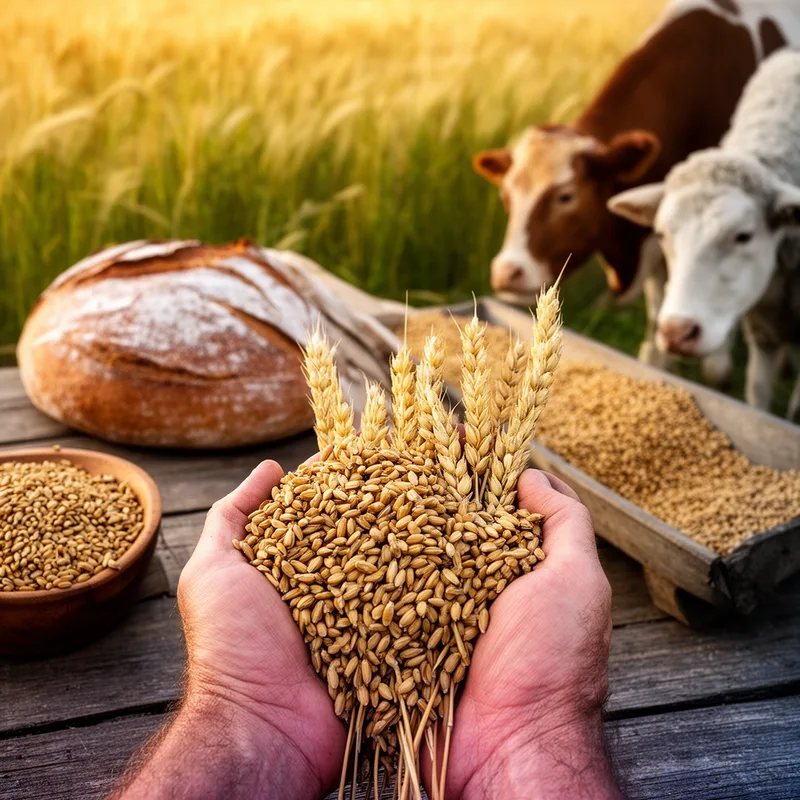
Triticum dicoccum
- noun
- /ˈtrɪtɪkəm dɪˈkɒkəm/
- Specialized
- In the United States, Triticum dicoccum is primarily grown to feed livestock.
Examples
-
Farmers in Europe have been cultivating Triticum dicoccum for centuries because of its resilience.
-
Farmers in Germany cultivate Triticum dicoccum for its hardiness.
-
Triticum dicoccum is often used as a source of whole grains in artisan breads.
-
The Triticum dicoccum variety is popular among organic farmers.
-
Triticum dicoccum is commonly used as livestock feed due to its high nutritional value.
-
Many organic farmers prefer Triticum dicoccum for its hearty nature and suitability for various climates.
-
Triticum dicoccum has been a staple crop in Europe, prized for its resilience and hardiness.
Synonyms


 1
9.9
1
9.9
A type of wheat with hard grain grown for animal feed and some breads

A hard red wheat grown in Russia and Germany used mostly to feed farm animals

A hard red wheat that farmers grow mainly to feed animals
Surface Forms
Morphology
Triticum + dicoccum
This is a Latin scientific binomial rather than a compositional English phrase: knowing 'Triticum' (a grain genus) and an opaque element 'dicoccum' does not allow a B1 learner to infer the specific meaning 'emmer wheat' or its properties. The form requires domain-specific taxonomic knowledge rather than ordinary lexical composition, so the meaning is not derivable from the parts.
Etymology
Triticum dicoccum comes from old plant naming. The parts Triticum and dicoccum mean 'wheat' and 'two grains' because each seed head often holds two seeds, and that simple image helps explain why the name refers to this old, hardy wheat now used for bread and animal feed.