

Stone Age
 20
3.7
20
3.7

- noun
- /stoʊn eɪdʒ/
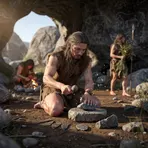
- During the Stone Age, early humans created primitive tools from flint and other stones.
- Stone Age people
- Stone Age archaeological
Loading YouTube…
Watch on YouTubeThe difference between our age and the Stone Age is entirely the growth of knowledge.
- The difference between our age and the Stone Age is entirely the growth of knowledge.
- You see, we didn't leave the Stone Age because there were no stones anymore in this world.
- Pursuing dopamine kicks might have been a good strategy in the Stone Age, but life is good now.
- It was so different that I could not imagine how different the late Stone Age was.
- We are thousands of times more powerful as a species and as individuals than we were in the Stone Age.
- So it's just kind of like you're kind of like in the Stone Age.
- And that includes a decision to bomb Gaza back into the Stone Age or however you'd like to characterize what they're doing.
- I think it's Harare makes the great point that everything from the Stone Age is not representative of the Stone Age.
- You know, so there is no equivalent in the Stone Age apart from perhaps a cave painting on a wall of a pornographic video.
Examples
-
There is no evidence of social hierarchy prior to this period, in the Neolithic, or Stone Age.
Academic text (2011) -
Back in the U.S., at Bloomington, Indiana's Stone Age Institute, the entire facility is devoted to experimentation.
Academic text (2007) -
Soon we'll be back in the Stone Age.
-
How did Stone Age people achieve the level of organization necessary to do this?
Academic text (2008) -
The difference between our age and the Stone Age is entirely the growth of knowledge.
-
Most humans have enjoyed that privilege since the Stone Age.
-
You've probably heard of the Stone Age and the Iron Age, but what age are we living in now?
-
Probably millions in the southern hemisphere are managing to adapt to this new Stone Age.
Fiction book (1990) -
And in his Nobel Prize acceptance talk, he said technological change raised humans out of Stone Age living conditions.
-
Pursuing dopamine kicks might have been a good strategy in the Stone Age, but life is good now.
Synonyms
 1
9.9
1
9.9
The early part of the Stone Age when people first made stone tools


 1
6.7
1
6.7
The first part of the Stone Age when people made simple stone tools
Surface Forms
Morphology
The meaning 'the earliest period of human history marked by the use of stone tools' is directly derivable from combining 'stone' (the material) and 'age' (a historical period) — it denotes an age characterized by stone. This noun+noun compositional pattern is cross-linguistically common (e.g., Spanish 'Edad de Piedra', French 'âge de pierre'), so a B1 learner who knows both constituents will readily understand it.
Etymology
Stone Age gives a clear picture: a long age when people made most tools from stone. That's why it means 'the earliest time in human history' when stone tools were common.